Follow us
Tata Motors CV Unit Targets 40% Market Share by FY28, Banks on IVECO Deal and Digital Platforms
Commercial vehicle business outlines FY28 targets of 40% market share and double-digit margins, while positioning the IVECO acquisition and digital platforms as growth drivers.
 By Shahkar Abidi
 2749 Views


Tata Motors Limited's commercial vehicle business told investors on June 23 that it aims to achieve a 40% domestic market share (VAHAN-based), double-digit EBITDA margins through the cycle and margins in the teens during upcycles, and a 30-35% return on capital employed (post-IVECO) by FY28. These targets are built on a record FY26 performance and a pending acquisition of Italy's IVECO Group.
The numbers from FY26, the company's first full year as a standalone listed entity since its October 2025 demerger, give management room for confidence. Wholesale volumes reached 428,000 units, up from 377,000 a year earlier. Revenue rose to Rs 77,399 crore. EBITDA margin improved to 13.2%, from 12.0% in FY25. Free cash flow reached Rs 9,186 crore, about 12% of revenue. Auto ROCE stood at 72%, which Tata says is among the highest in the global industry.
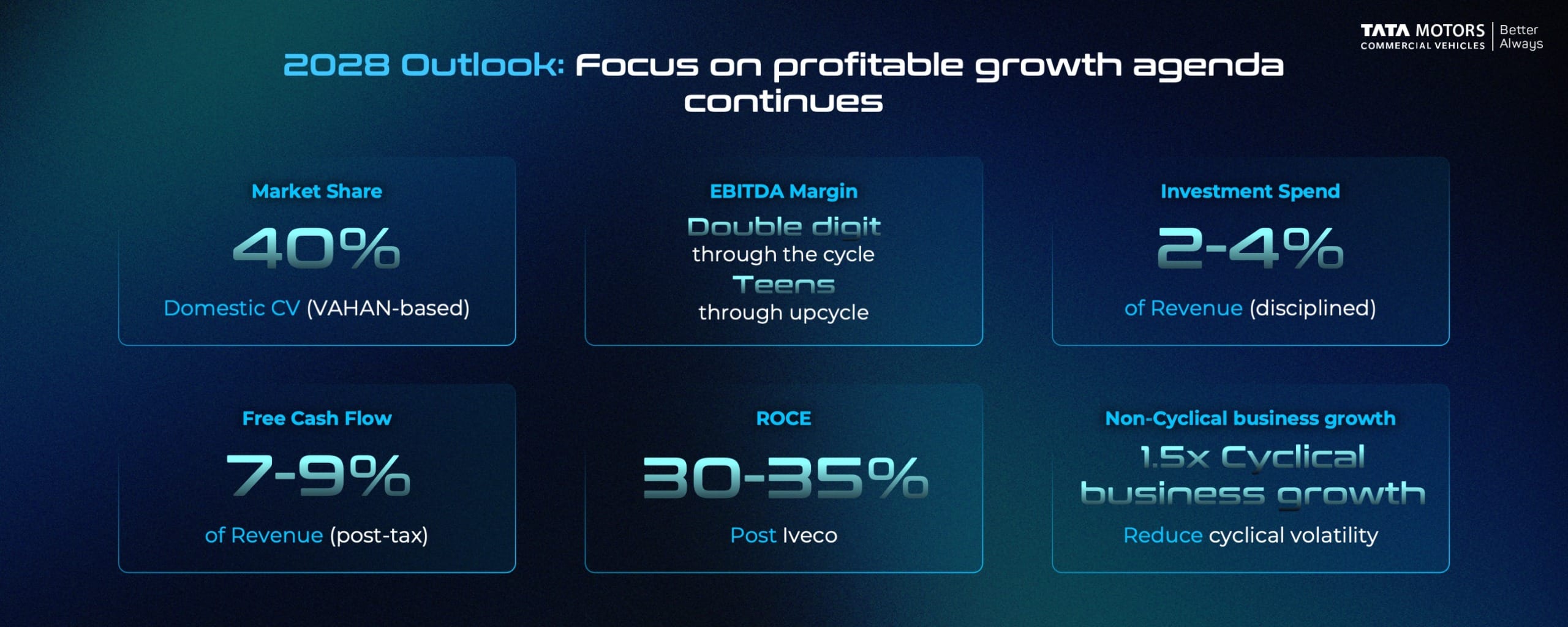 Not everything moved in the right direction. Total CV market share fell to 35.7% in FY26 from 37.1% the previous year, dragged down by share losses in ILMCV, small commercial vehicles/pickups and commercial passenger vehicles, even as the truck business retained its HCV leadership with roughly 55% market share. The SCV-PU segment, in particular, needs what management described as a focused reset, with share declining to 26.8% for the year despite 8.2% volume growth. Closing the gap to 40% by FY28 will require reversing share erosion in three of four sub-segments, not just defending the one where Tata already leads.
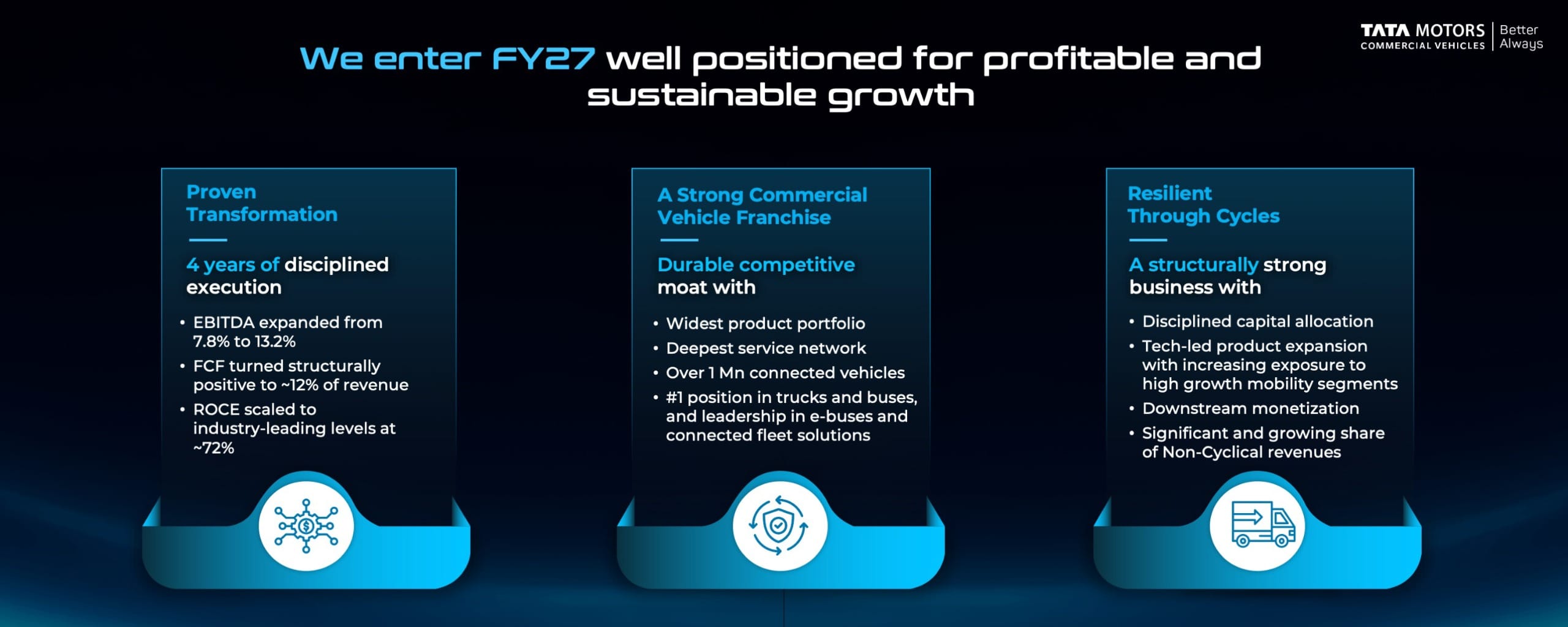 The deal, expected to close by Q2 FY27, would make Tata Motors the world's fourth-largest commercial vehicle player, according to the company, combining its low-cost, mass-market truck portfolio with IVECO's premium, low-emission lineup across Europe, Latin America and Australia/New Zealand—markets where Tata currently has no presence. Most regulatory approvals are already in place.
Tata's Fleet Edge and Freight Tiger platforms, now folded into a new entity called AIEQU Mobility, posted tangible growth. Fleet Edge crossed 1 million connected vehicles. The company's stated five-year ambition is to become "the world's first OE-agnostic, AI-native logistics operating system", with 3 million vehicles on the platform.
Management flagged commodity cost volatility, geopolitical supply-chain disruptions and potential interest-rate headwinds in FY27 as near-term risks, though it described all three as cyclical and manageable against what it sees as durable structural tailwinds, including India's 6-7% GDP growth, fleet electrification mandates and recurring digital revenue from its connected vehicle base.

RELATED ARTICLES

GARC Upgrades Automotive Testing Infrastructure Under PM E-DRIVE
 Eshisha Java
 28 Sep 2026
The Chennai-based testing agency is adding EV, battery, ADAS, crash safety and heavy commercial vehicle testing capabili...


Renault India Sees Hybrids As Major Volume-Generating Powertrain In Medium Term
Kiran Murali
28 Sep 2026
The automaker is betting on strong hybrids as it expands its product portfolio and prepares for a shift in India's power...

Renault India Eyes 500 Showrooms By End Of 2027
Kiran Murali
28 Sep 2026
The automaker is planning to expand its retail footprint as it looks at a product portfolio of seven models by the end o...