Follow us
Porsche issues global recall for Taycan models made since launch in 2020
Less than 1 percent of all Taycans affected, claims Porsche.
 28 Jun 2024
 9677 Views
Share -
9677 Views
Share -


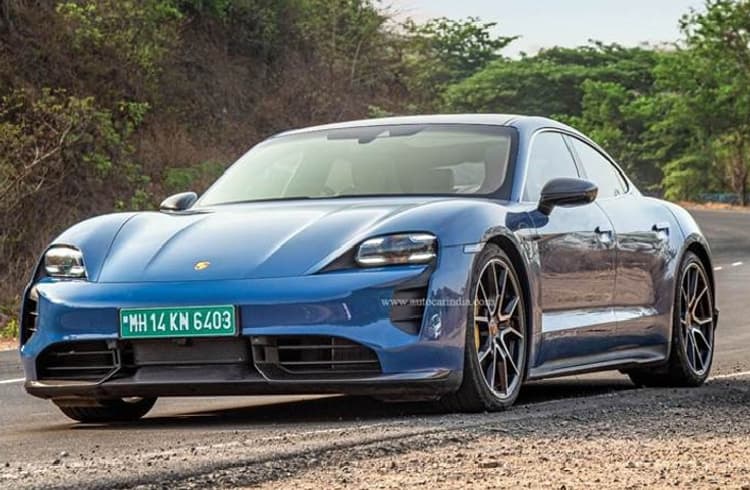
Porsche has issued a global recall for all Taycan models manufactured since its launch in 2020. The German carmaker has identified a braking issue that has affected a small number of cars but insists that it remains safe to drive. It has not disclosed the precise number of cars affected by the recall, but it has sold more than 150,000 examples worldwide so far.
Porsche Taycan recall: what’s the issue?
Porsche has noted an issue concerning the front brake hoses, with a small number of cars developing cracks that cause brake fluid to leak out, thereby reducing brake pressure and the effectiveness of the system.
Cars that develop the fault will display a warning light on the dashboard. If owners see a warning light, they should drive their car to a dealership. If a red light appears, they should contact Porsche and refrain from using the car. Cars that do not show a warning light remain safe to drive.
"We conducted some internal quality analysis and determined that failures can occur in certain special cases,” said Taycan project manager Kevin Giek to our sister publication Autocar UK. “Safety is our top priority, so we decided to optimise the brake hoses on the front axle and planned a new design," he added.
“We have redesigned the hoses with new length, braking points and a new kinematic, and that makes us very sure that we won’t see this failure anymore.”
How will it be resolved?
Porsche will write to owners, inviting them to bring their cars to dealerships to have the replacement hose fitted. The work will take around two hours, will be done free of charge and will not affect the warranty.
Giek said the issue has been identified in less than 1 percent of all Taycan models sold globally, but added, “For us, this is enough to react. Most cases happen when the car is standing, and then you get the yellow warning message mostly when you are not driving the car.” Instances have been reported across various countries.
Porsche conducted extensive testing of the Taycan before its launch, and again with the recently launched facelifted model. However, Giek said that in more than 5 million miles of testing, they hadn’t encountered a single example of the braking issue during that period.
He added, “The first complaints we received made us to ask ‘what could have happened?’ So we did a deep-dive quality analysis on a few of the cases. We are not at the point where we can say that only one market or a small number is affected, so we decided to make a new, robust design even though if it’s not needed.”

RELATED ARTICLES

Weekly News Wrap: Festive Sales Surge, Citroen Eyes India EV Production, BKT-Pirelli Plan JV
 Darshan Nakhwa
25 Oct 2026
Darshan Nakhwa
25 Oct 2026
Festive demand drives vehicle sales, while automakers outline new electric vehicle plans, Tata Motors projects double-di...


Castrol India Q32026 Net Profit Drops 23% to Rs 176 Crore as Input Costs Surge
 Dev Vadchhedia
24 Oct 2026
Dev Vadchhedia
24 Oct 2026
The lubricants maker recorded 27 percent revenue growth, but raw material inflation and currency headwinds pressed profi...

Paradeep Parivahan Secures 10-Year EV Heavy Haulage Contract From JSW Group
 Autocar Professional Bureau
24 Oct 2026
Autocar Professional Bureau
24 Oct 2026
The logistics provider will deploy 100 electric trucks for industrial transport across Andhra Pradesh and Karnataka.