Follow us
Keto Motors Obtains Government Certification for 9-Metre Electric Bus
The Hyderabad-based EV manufacturer has cleared a key regulatory hurdle, opening the door to commercial sales across public transport and fleet operators in India.
 By Angitha Suresh
 1249 Views


Keto Motors has received CMVR Type Approval Certification from the Global Automotive Research Centre (GARC) for its Urbanova KE9, a 9-metre electric bus, the company announced on March 5. The certification clears the vehicle for commercial deployment across India and marks a significant step in the company's expansion across the country's electric public mobility segment.
The approval confirms that the Urbanova KE9 meets all statutory requirements under India's Central Motor Vehicles Rules, covering structural integrity, passenger safety, range efficiency, and operational reliability. With the certification in hand, Keto Motors said it is initiating customer demonstrations and preparing deliveries for State Transport Undertakings (STUs), employee transportation providers, school fleets, and urban mobility operators transitioning away from diesel-powered vehicles.
"Securing CMVR Type Approval for the Urbanova KE9 is a defining milestone for Keto Motors," said Venkatesh Challa, Director of Keto Motors. "This certification reinforces our commitment to delivering dependable, high-performance electric mobility solutions designed specifically for Indian roads and fleet operators. With approvals in place, we are now focused on accelerating customer deployments and supporting India's transition toward clean, zero-emission public transport."
Vehicle Specifications
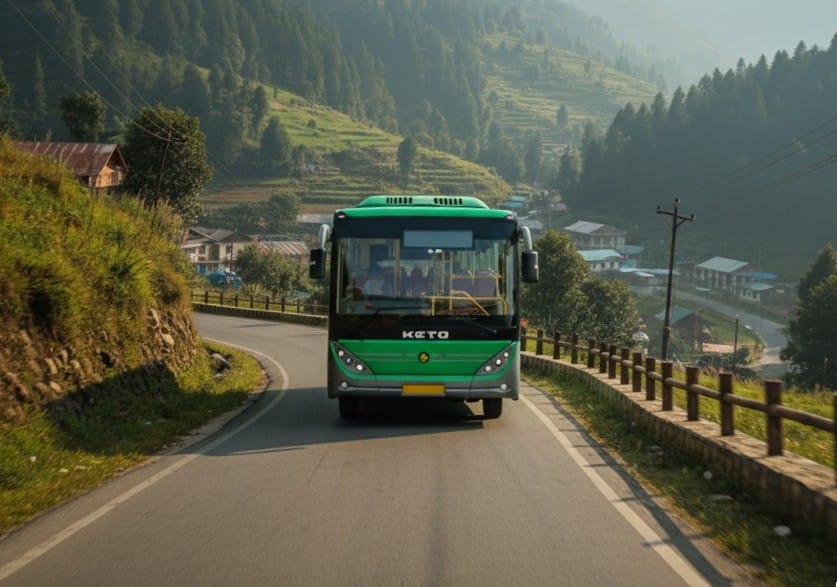 The Urbanova KE9 is built on an urban-grade chassis suited for STU operations and smart city networks. It is rated for a maximum range of 225 km and a cruise range of 188 km under Indian Driving Cycle (IDC) conditions. Power comes from a 245 kW liquid-cooled permanent magnet synchronous motor producing 3,000 Nm of torque, enabling reliable performance across steep gradients and dense urban traffic.
The bus accommodates 31 seated passengers with standing room for an additional 11, and supports a top speed of 80 km/h with 20% gradability. Standard features include CCS2 fast charging compatibility, air suspension, anti-lock braking, regenerative braking, and electro-hydraulic power steering with disc brakes — a combination the company says is aimed at improving passenger comfort, enhancing vehicle control, and reducing operating costs while maximising fleet uptime.
Manufacturing and Production
Production of the KE9 is scheduled to commence in early FY26. Manufacturing will take place at Keto Motors' 20-acre integrated production facility in Jadcherla, Telangana. The plant is equipped with advanced testing systems and handles end-to-end production, including in-house bus body manufacturing. The company said the facility enables stringent quality control and faster scale-up for both commercial and public mobility applications. Keto Motors has an annual production capacity of 1,000 units and plans to scale deliveries across the country on a pan-India basis.
Technology Partnership
Keto Motors' product development is supported by a technology partnership with TRON, described by the company as Taiwan's largest electric bus original equipment manufacturer. Through this arrangement, Keto Motors gains access to patented liquid-cooled battery technology, a self-developed battery management system (BMS), and fleet management systems (FMS). The company said this collaboration strengthens its ability to deliver buses tailored to Indian operating conditions.
The company's existing product range holds approvals from ICAT and ARAI, India's two primary automotive testing and certification bodies, and Keto Motors maintains a nationwide service network to support fleet operators post-deployment.
Broader Product Plans
Beyond the 9-metre platform, Keto Motors said it is developing both 12-metre and 6-metre electric bus variants. The company said these models will complement the KE9 and broaden its presence across major public transport and commercial mobility segments, positioning it to address a wider range of operator requirements.
Keto Motors was founded in 2018 and is headquartered in Hyderabad. The company holds ISO 9001:2015 certification and describes its focus as developing electric vehicle solutions suited to Indian road and urban transport conditions. It is supported by a team of industry professionals, strategic supplier partnerships, and a nationwide service ecosystem.
CMVR, or Central Motor Vehicles Rules, governs vehicle safety and performance standards in India. Type Approval under this framework is a mandatory regulatory requirement before a vehicle can be sold commercially in the country, covering performance, safety, and emissions criteria set by the Ministry of Road Transport and Highways.

RELATED ARTICLES

Volvo Cars names Skoda’s Klaus Zellmer as new president, CEO
 Autocar Professional Bureau
 20 Sep 2026
Zellmer will take the new role in October 2027.


Volvo’s 20:1 Compression Ratio Breakthrough: How Dual-Wave Pistons Could Deliver 4% Fuel Savings for Indian Fleets
 Shahkar Abidi
20 Sep 2026
Shahkar Abidi
20 Sep 2026
A decade after its engineers reshaped the piston crown and halved diesel soot, Volvo has doubled down, on the design at ...

Weekly News Wrap: Record Auto Sales Spur Production Push, Fresh Investments
 Darshan Nakhwa
20 Sep 2026
Darshan Nakhwa
20 Sep 2026
The week saw Kia and Hyundai raise production on strong demand, passenger vehicle and scooter volumes hSemiit fresh hig...