Follow us
India's Two-Wheeler Retail Hits Record High in February 2026
Two-wheeler sales crossed 17 lakh units in February, the highest ever for the month, driven by rural demand, GST revisions, and the marriage season.
 By Angitha Suresh
 947 Views


India's two-wheeler retail segment posted its best-ever February performance in 2026, with 17,00,505 units sold — a 25.02% increase compared to February 2025, according to data released by the Federation of Automobile Dealers Associations (FADA) on March 5, 2026. The result surpassed the previous February record set in 2024 and came despite the month being shorter than most others in the calendar year.
The performance was part of a broader industry-wide surge. Overall vehicle retail across all categories reached 24,09,362 units in February 2026, up 25.62% year-on-year, with five out of six vehicle categories registering their highest-ever February volumes. Two-wheelers, which account for the largest share of overall vehicle retail in India, were central to this outcome.
Growth was recorded across both urban and rural markets. Urban retail rose 28.96% year-on-year, while rural retail grew 22.16% over the same period. Urban markets registered a slightly higher percentage gain in February, though rural demand has remained a consistent and structurally important driver of two-wheeler volumes across recent months. Data from FADA's Vehicle Retail Strength Index shows that rural markets have accounted for a majority share of two-wheeler retail consistently through FY26, standing at 56.6% of total two-wheeler retail in February 2026, compared to 43.4% from urban regions.
Dealers attributed the February performance to several converging factors. Improved rural liquidity, following positive crop outcomes in the preceding harvest season, gave consumers in agrarian markets greater purchasing capacity. The ongoing marriage season traditionally accelerates demand for personal mobility, particularly in semi-urban and rural areas. New model introductions by manufacturers also supported fresh inquiries and footfalls at dealerships during the month.
A significant policy factor underpinning the February momentum was the government's GST 2.0 framework, announced earlier in the year. The revision reduced tax burdens on select vehicle categories and appears to have boosted consumer sentiment considerably. FADA has noted that affordability improvements following the GST changes have been among the key demand drivers across multiple vehicle segments, with two-wheelers being a primary beneficiary given their price sensitivity.
On a month-on-month basis, two-wheeler sales declined 8.22% from January 2026's 18,52,870 units. This sequential dip, however, is consistent with historical patterns for February and is largely attributed to the month's shorter duration rather than any weakening of underlying demand.
Some constraints did temper what could have been an even stronger performance. Dealers in certain regions flagged supply-side issues, with select popular models facing availability gaps. School and college board examinations in parts of the country also reduced footfall at dealerships during the month, as prospective buyers deferred purchases.
On the manufacturer side, Hero MotoCorp retained its position as the market leader with 4,57,826 units sold and a 26.92% market share in February 2026, though its share was marginally lower than the 28.43% it held in February 2025. Honda Motorcycle and Scooter India came in second with 4,31,253 units and a 25.36% share, gaining ground from 24.25% a year ago. TVS Motor Company ranked third with 3,33,935 units and a 19.64% share, up from 18.72% in February 2025, indicating a steady gain in competitive positioning.
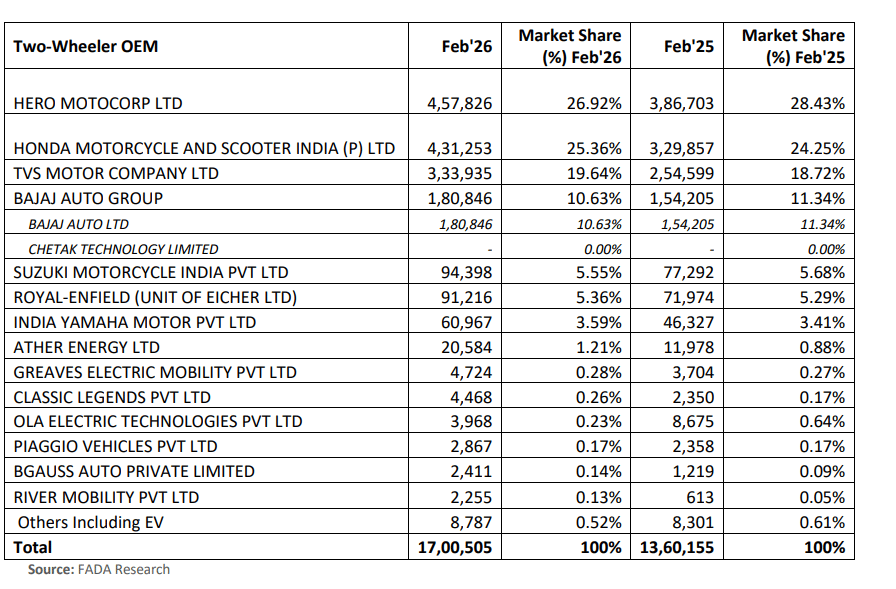 Bajaj Auto sold 1,80,846 units with a 10.63% share, while Suzuki Motorcycle India and Royal Enfield followed with shares of 5.55% and 5.36% respectively. India Yamaha Motor accounted for 3.59% of the market.
Among electric two-wheeler makers, Ather Energy was a notable gainer, with its market share rising to 1.21% in February 2026 from 0.88% a year earlier, selling 20,584 units. In contrast, Ola Electric saw its share fall sharply to 0.23% from 0.64% in February 2025, with volumes dropping from 8,675 units to 3,968 units over the same period — a decline that stands out given the broader market's strong growth trajectory.
From a fuel-mix perspective, petrol and ethanol-blended vehicles continued to dominate the two-wheeler segment, accounting for 93.34% of retail in February 2026, broadly stable from 93.27% in January 2026 and 94.06% in February 2025. Electric two-wheelers accounted for 6.57% of the category, up from 5.64% in February 2025, reflecting a gradual but steady shift in consumer preference toward electric mobility, even as the pace of EV adoption in two-wheelers remains measured.
For the financial year to date — covering April 2025 through February 2026 — cumulative two-wheeler retail stood at 1,94,58,477 units, a 12% increase over the 1,73,73,374 units recorded in the same period of FY25. This positions the segment for a strong full-year close ahead of the March 2026 financial year-end.
Looking ahead, FADA's dealer sentiment survey indicates a cautiously optimistic outlook for the two-wheeler segment in March 2026. Booking pipelines are described as healthy, with improved agricultural incomes, post-examination demand and the confluence of festivals — including Navratri, Ramzan, Ugadi, Gudi Padwa and Eid — expected to support retail momentum through the month. Financial year-end purchasing dynamics are also anticipated to contribute positively.
For the three-month period from March to May 2026, sentiment is more measured. While 67.35% of dealers surveyed expect growth, this figure is lower than the 79.70% who had expected growth in the previous survey covering February to April 2026. FADA indicated that the market may be transitioning from a sharp post-GST rebound phase to a more stable and calibrated growth trajectory. Potential risks flagged by dealers include elections in certain states, supply-side uncertainties, and possible fuel price volatility arising from global developments.

RELATED ARTICLES

Volvo Cars names Skoda’s Klaus Zellmer as new president, CEO
 Autocar Professional Bureau
 20 Sep 2026
Zellmer will take the new role in October 2027.


Volvo’s 20:1 Compression Ratio Breakthrough: How Dual-Wave Pistons Could Deliver 4% Fuel Savings for Indian Fleets
 Shahkar Abidi
20 Sep 2026
Shahkar Abidi
20 Sep 2026
A decade after its engineers reshaped the piston crown and halved diesel soot, Volvo has doubled down, on the design at ...

Weekly News Wrap: Record Auto Sales Spur Production Push, Fresh Investments
 Darshan Nakhwa
20 Sep 2026
Darshan Nakhwa
20 Sep 2026
The week saw Kia and Hyundai raise production on strong demand, passenger vehicle and scooter volumes hSemiit fresh hig...