Follow us
India's Two-Wheeler Output Surges 28% in April as Motorcycle and Scooter Demand Climbs
Production crossed 23.7 lakh units in April 2026, with exports rising sharply; Hero MotoCorp and Bajaj Auto led volume gains across segments.
 1562 Views


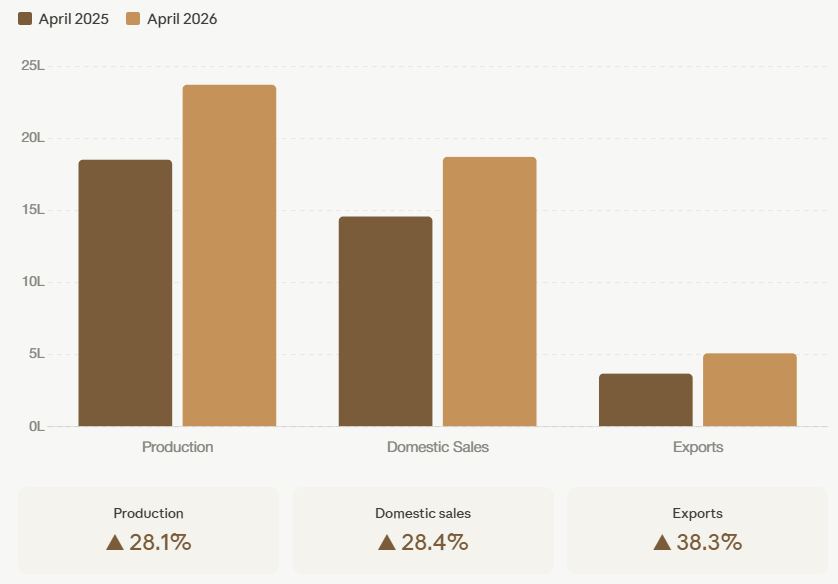
India's two-wheeler industry recorded a broad-based increase in April 2026, with production reaching 23,73,587 units against 18,52,866 units in April 2025, according to data released by the Society of Indian Automobile Manufacturers (SIAM). Domestic sales rose to 18,72,691 units from 14,58,784 units a year earlier, while exports climbed to 5,09,199 units from 3,68,201 units over the same period.
The growth spanned all three two-wheeler sub-segments — motorcycles, scooters, and mopeds — with motorcycles accounting for the bulk of the overall volume. The figures cover production, domestic sales, and exports for the month of April 2026 and are compared with April 2025 data from the same SIAM report series.
The two-wheeler segment contributed the largest share of the overall automobile industry's output in April 2026, which recorded a grand total of 29,22,427 vehicles produced across all categories. Of this, two-wheelers alone accounted for approximately 81%, underscoring the segment's central role in Indian vehicle manufacturing. The combined domestic sales figure of 18,72,691 units for two-wheelers also represented the largest share of total industry domestic sales of 23,16,671 units.
The increase in exports is a particularly notable development. At 5,09,199 units, two-wheeler exports in April 2026 accounted for over 81% of total vehicle exports across all segments for the month, which stood at 6,28,128 units. This reflects the established position of Indian manufacturers as significant suppliers to international markets, especially for mass-market motorcycles and scooters.
 Motorcycles
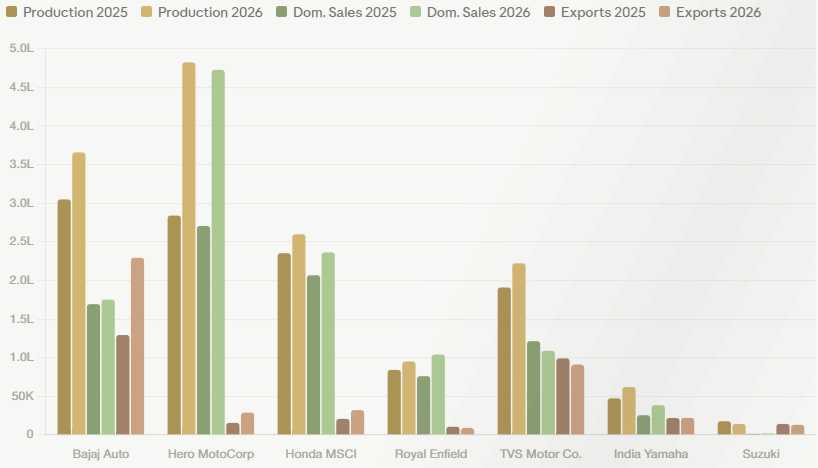
The motorcycle segment produced 15,02,645 units in April 2026, up from 11,66,462 units a year earlier — a rise of nearly 29%. Domestic sales stood at 11,38,452 units compared with 8,71,666 units in April 2025. Exports from this segment reached 4,26,499 units, a significant increase from 3,13,008 units.
Hero MotoCorp was the largest contributor to the gain, with production rising to 4,82,449 units from 2,84,064 units — an increase of nearly 70% year-on-year. The company's domestic sales reached 4,72,918 units, up from 2,70,546. A significant portion of this volume came from the 75–110 CC sub-segment, where Hero MotoCorp produced 3,95,050 units under models including the HF Deluxe, Passion, and Splendor series.
Bajaj Auto produced 3,65,863 units in April 2026 against 3,04,956 in April 2025, and exported 2,29,326 units — the highest motorcycle export number among all manufacturers in the segment. The company's export growth was driven by its sub-110 CC portfolio, which includes the CT and Platina ranges, as well as mid-displacement models in the 110–125 CC bracket. Honda Motorcycle and Scooter India produced 2,59,798 units and sold 2,36,363 units domestically, with the 110–125 CC sub-segment — covering the CB 125 Hornet and Shine — contributing 1,74,775 units of production.
Royal Enfield, the motorcycle brand under Eicher Motors, produced 95,134 units and recorded domestic sales of 1,04,129 units in April 2026, compared with 76,002 units sold domestically in April 2025. The bulk of Royal Enfield's volume came from the 250–350 CC category, which includes the Bullet 350, Classic 350, Hunter 350, and Meteor 350, with production in that band reaching 73,100 units. The 350–500 CC category, covering the Himalayan and Guerrilla 450, added a further 5,807 units in production, and the 500–800 CC twins segment contributed 5,945 units.
TVS Motor Company produced 2,22,189 units and exported 91,132 units, though its domestic sales declined modestly to 1,08,907 units from 1,21,420 units a year earlier. India Yamaha Motor produced 61,910 units and sold 38,450 units domestically, with exports at 22,039 units. Suzuki Motorcycle India's production fell slightly to 14,143 units from 17,665, while its domestic sales edged up to 1,821 units from 1,359.
Among engine capacity sub-segments, the 75–110 CC category remained the highest-volume band with production of 5,89,294 units, followed by the 110–125 CC band at 4,66,573 units. Both these entry-level commuter segments are central to rural and semi-urban demand. The 150–200 CC band reached production of 1,74,295 units, driven largely by Bajaj Auto, TVS Motor Company, and India Yamaha. The 250–350 CC segment, dominated by Royal Enfield, reached production of 1,00,681 units, up from 79,467 in April 2025. At the premium end, the 350–500 CC and 500–800 CC sub-segments together produced 24,172 units, indicating continued, if modest, interest in higher-displacement motorcycles.
Motorcycles — April 2025 vs April 2026 (Number of Vehicles)
 Scooters
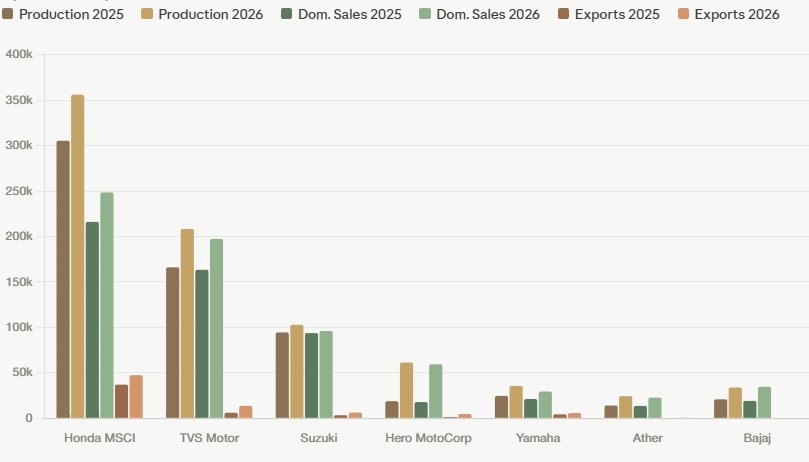
Scooter production rose to 8,27,750 units in April 2026 from 6,48,633 units in April 2025, a year-on-year increase of approximately 28%. Domestic sales increased to 6,91,993 units from 5,48,370 units, and exports from the scooter segment climbed to 80,810 units from 53,879 units — a rise of roughly 50% in export volume within a single year.
Honda Motorcycle and Scooter India retained the top position in scooters, producing 3,56,208 units and recording domestic sales of 2,48,609 units. The company's 90–125 CC sub-segment, which includes the Activa, Dio, and Navi, accounted for the bulk of production at 3,03,626 units. TVS Motor Company produced 2,08,452 units and sold 1,97,392 units domestically, with its Jupiter, Ntorq, and Zest models contributing the primary volumes. Suzuki Motorcycle India's scooter production crossed 1,03,018 units, maintaining its position as the third-largest scooter manufacturer, supported largely by the Access, Avenis, and Burgman range.
Hero MotoCorp showed a notable increase in scooter output, rising to 61,518 units from 18,966 units a year earlier, with domestic sales of 59,515 units against 17,978 units in April 2025. The Destini 125, Maestro, Pleasure, and Xoom range, along with the electric Vida, drove this expansion. India Yamaha Motor's scooter production reached 35,720 units from 24,730 units, with domestic sales growing to 29,538 units from 21,345 units.
Electric scooters continued to expand their share within the broader scooter category. The above-250W electric sub-segment (AE2), which covers models such as the Ather 450 series, Bajaj Chetak, TVS iQube, and Hero Vida, recorded combined production of 1,12,465 units in April 2026, compared with 71,031 units in April 2025. Domestic sales in this sub-segment reached 1,12,176 units from 68,439 units, indicating that consumer uptake of electric scooters has broadly kept pace with production. Ather Energy's production rose to 24,498 units from 14,145 units; Bajaj Auto's Chetak reached 33,426 units in production, up from 21,015; TVS Motor Company's electric scooter output grew to 37,802 units from 27,144 units; and Hero MotoCorp's Vida contributed 16,224 units in production. Suzuki's e-Access entered the data with 485 units produced in April 2026, a new addition not recorded in April 2025.
The sub-250W electric category (AE1), covering lower-powered models, saw Bajaj Auto's Yulu Ver 3.0x record production of 556 units and domestic sales of 500 units in April 2026, a segment absent in the prior year's data for that sub-band.
Scooters — April 2025 vs April 2026 (Number of Vehicles)
Mopeds
The moped segment, represented entirely by TVS Motor Company's XL series under the C1 sub-category (engine capacity up to 100 CC with fixed transmission), saw production rise to 43,192 units from 37,771 units in April 2025 — an increase of approximately 14%. Domestic sales reached 42,246 units compared with 38,748 units, while exports grew to 1,890 units from 1,314 units.
The XL moped occupies a distinct niche in the Indian two-wheeler market. It is primarily used for last-mile transport and small-load carrying in rural and semi-urban areas. The segment's consistent performance over successive years reflects stable demand from this demographic, though it remains a fraction of the overall two-wheeler market in volume terms. Unlike scooters and motorcycles, the moped category has not seen entry from electric variants in the SIAM-reported data for April 2026.
India is among the largest two-wheeler markets in the world, with annual domestic sales typically exceeding 150 lakh units. The sector serves a wide range of consumers — from entry-level commuter motorcycle buyers in rural and semi-urban areas to urban scooter users — and plays a significant role in the country's vehicle exports, particularly to markets in South Asia, Africa, and Latin America. Two-wheelers are also a primary mode of daily transport for a large share of the working population, making the segment sensitive to factors such as fuel prices, rural income levels, monsoon patterns, and consumer credit availability.
April marks the start of the new financial year in India. Manufacturers often use the period to introduce new model-year variants, launch refreshed products, and build production inventory ahead of the summer and pre-festival season. Retail sentiment at the start of a financial year is considered a useful early indicator of industry direction for the months ahead.
SIAM, the apex industry body for vehicle manufacturers, publishes monthly production, domestic sales, and export data for all registered segments and sub-segments. Report III provides segment and company-level data, while Report IV breaks figures further into sub-segments by engine capacity, vehicle length, price band, and other technical specifications. The two reports together allow a detailed view of volume distribution across product categories.
The electric two-wheeler space has seen increasing attention from both manufacturers and policymakers over recent years. Government incentives under schemes supporting electric vehicles, along with rising fuel costs and growing charging infrastructure, have contributed to the expansion in EV production and sales volumes now visible in the SIAM data. The AE2 sub-category — electric scooters with motor output above 250W — recorded combined domestic sales of 1,12,176 units in April 2026 alone, a figure that illustrates the pace at which electric scooters are entering mainstream purchase decisions.
The export performance of the two-wheeler segment reflects the competitive manufacturing base that Indian producers have developed for mass-market, fuel-efficient vehicles. Bajaj Auto, TVS Motor Company, and Honda Motorcycle and Scooter India are among the largest contributors to export volumes. Markets in Africa, South and Southeast Asia, and parts of Latin America have historically been recipients of Indian-manufactured two-wheelers, particularly in the sub-125 CC motorcycle and commuter scooter categories.
The broad expansion in production volumes across companies in April 2026, particularly in the motorcycle and electric scooter segments, reflects continued consumer demand and manufacturer investment in capacity. With total two-wheeler production crossing 23 lakh units and exports exceeding 5 lakh units in a single month, the April 2026 figures represent a high-water mark for the industry in recent comparable periods.

RELATED ARTICLES

VIDA Launches Limited-Edition Electric Off-Roader at 100th FIM International Six Days Enduro
 Angitha Suresh
 16 Oct 2026
Hero MotoCorp's electric vehicle brand VIDA has released a 100-unit numbered edition of its youth off-road bike in partn...


Jio-bp and Kia India Integrate EV Charging Networks
Angitha Suresh
16 Oct 2026
The partnership links Jio-bp's 7,000+ charging points to the MyKia app, while Kia's dealership chargers will be added to...

Royal Enfield Opens Registrations for 125th Anniversary Edition Hypershift Classic 650, Priced at Rs 4.25 Lakh
 Autocar Professional Bureau
16 Oct 2026
Autocar Professional Bureau
16 Oct 2026
The limited edition is capped at 125 units per key region globally, with deliveries starting in November 2026.