Follow us
India's Shift to E20 Was More Than Two Decades in the Making: Centre
Petroleum ministry says the programme moved from pilot projects and E5 supplies to E20 through phased policy changes, investment and capacity expansion.
 By Darshan Nakhwa
 1388 Views


India’s ethanol-blending programme began with a pilot project in 2001 and was not introduced only in the past few years, the Ministry of Petroleum and Natural Gas has said while rejecting claims that the country rushed its transition to E20 petrol.
The pilot programme was formally announced in 2004. Petrol containing 5% ethanol, or E5, was subsequently introduced across several states by 2006, the ministry said in a question-and-answer note issued on July 10.
The policy framework was later notified in the Gazette of India in January 2013. However, ethanol blending remained at around 1.5% until 2014, mainly because India did not have enough production capacity, the ministry said.
The government was responding to criticism that India advanced its ethanol-blending targets too quickly compared with countries such as Brazil, which took several decades to build a large ethanol fuel market.
The Centre had initially set 2030 as the target for achieving 20% ethanol blending in petrol. However, the Cabinet Committee on Economic Affairs advanced the target to 2025, bringing the rollout forward by five years. The ministry said the faster transition was supported by higher ethanol production capacity, a wider feedstock base and investment in distilleries, storage and supply infrastructure.
According to the ministry, India’s programme developed over more than two decades through pilot projects, policy changes, the expansion of feedstocks, investment in distilleries, and consultation with vehicle manufacturers and other stakeholders.
Limited Capacity Slowed Early Progress
India initially depended almost entirely on sugarcane for ethanol production. Annual capacity stood at around 400 crore litres, which was not enough to support higher blending levels across the country, the ministry said.
The government changed its approach after introducing the National Policy on Biofuels in May 2018. The policy expanded the range of raw materials that could be used to make ethanol and encouraged investment in additional production capacity.
Several ministries worked together to expand feedstocks, improve logistics, build infrastructure, and provide greater certainty to ethanol producers, according to the release. These included the petroleum, food distribution, road transport, and heavy industries ministries.
A major step came in 2021 when Indian Oil Corporation, Bharat Petroleum Corporation, and Hindustan Petroleum Corporation invited proposals for dedicated ethanol plants in ethanol-deficit regions.
The projects were supported by long-term purchase agreements from oil marketing companies and financing arrangements with public-sector banks. The ministry said these measures reduced investment risk and helped attract fresh capacity.
Supply Expansion Supported Higher Target
The NITI Aayog roadmap for ethanol blending was also published in June 2021, following consultations with vehicle manufacturers, oil companies, agricultural experts, and other stakeholders.
At that time, India required about 500-600 crore litres of ethanol annually to achieve 10% blending. As investment increased, the country’s potential production capacity was expected to rise to nearly 1,200 crore litres, the ministry said.
The Centre said the move towards 20% blending became feasible only after the supply side improved.
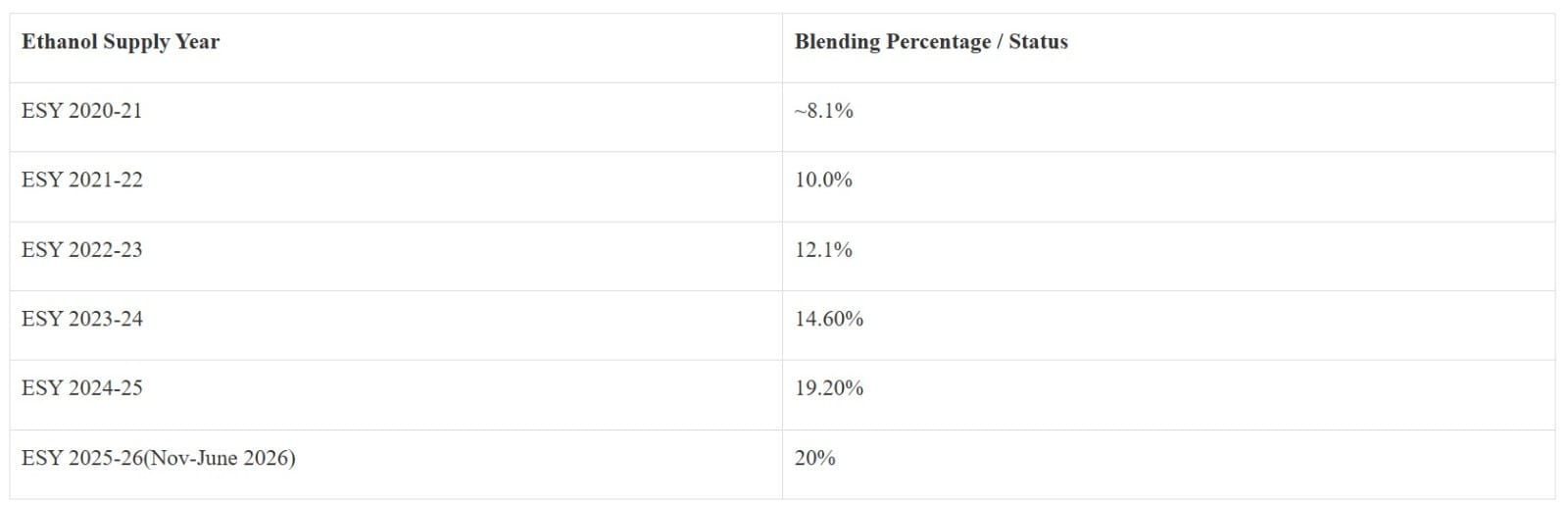 India reached 10% average ethanol blending in the 2021-22 ethanol supply year. This rose to 12.1% in 2022-23, 14.6% in 2023-24, and 19.2% in 2024-25. Average blending reached 20% between November 2025 and June 2026, according to the ministry.
The progression shows that the blending level increased in stages rather than through a single nationwide shift, it added.
Centre Cites Global Learning
The ministry said Brazil took longer because it was developing one of the world’s first large-scale ethanol ecosystems. India, by comparison, could learn from technologies, policies, and operating experience already available in international markets.
The Centre said better coordination between ministries, a clearer investment framework, and the use of proven technology allowed India to shorten the implementation period.
It maintained that the faster timeline did not come at the cost of technical evaluation or vehicle safety. Automobile manufacturers, testing agencies, oil companies, and other stakeholders were consulted before the rollout.

RELATED ARTICLES

Gabriel India and Forvia Formally Incorporate Seating JV Entity, Named Faurecia Anand Seating India
 Autocar Professional Bureau
 19 Oct 2026
Faurecia Anand Seating India incorporated with an initial paid-up equity capital of Rs 20 crore.


Mahindra Expands Ahmedabad Network with Upgraded Flagship Outlet
 Dev Vadchhedia
19 Oct 2026
Dev Vadchhedia
19 Oct 2026
Mahindra strengthens regional footprint through Param Automotive’s upgraded flagship facility.

JLR India Relocates Mumbai Retailer to Bandra Kurla Complex
 Shruti Shiraguppi
19 Oct 2026
Shruti Shiraguppi
19 Oct 2026
The Navnit Motors facility displays Range Rover, Defender and Discovery models alongside certified pre-owned vehicles.