Follow us
India's Electric Two-Wheeler Sales Dip in February 2026, but Annual Growth Holds Firm
Total retail registrations fell 9% month-on-month to 1,11,709 units, even as year-on-year volumes rose 45.6%, signalling sustained long-term demand for electric two-wheelers.
 By Angitha Suresh
 1169 Views


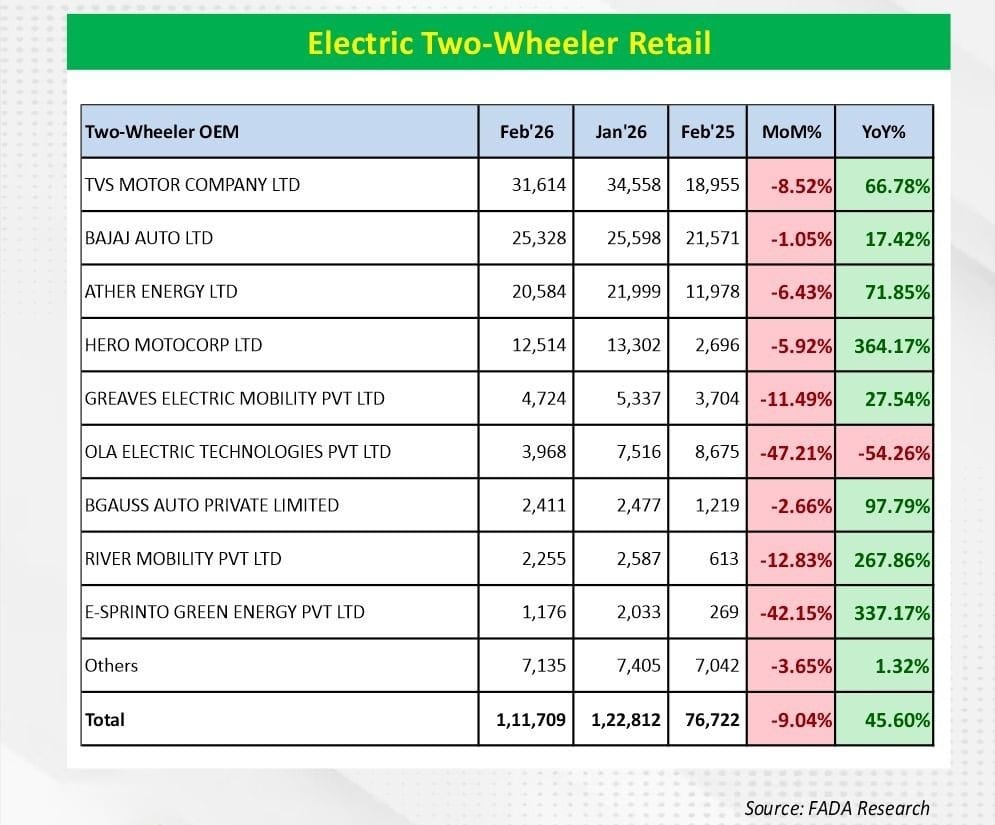
Electric two-wheeler retail sales in India fell to 1,11,709 units in February 2026, down 9.04% from 1,22,812 units in January 2026, according to data released by the Federation of Automobile Dealers Associations (FADA). Despite the monthly contraction, sales were 45.6% higher than the 76,722 units recorded in February 2025, pointing to an underlying growth trajectory in the segment. The figures were compiled as of March 2, 2026, in collaboration with the Ministry of Road Transport and Highways, Government of India, covering 1,459 of 1,464 Regional Transport Offices and excluding figures from Telangana.
The 2W EV market share as a percentage of total two-wheeler retail held steady at 6.6% in February 2026, unchanged from January 2026 and up from 5.6% in February 2025. While the month-on-month share remained flat, the year-on-year improvement of one percentage point reflects a gradual but consistent shift in consumer preference toward electric mobility, particularly in the urban commuter segment where two-wheelers remain the dominant mode of personal transport.
 TVS and Bajaj Consolidate Their Lead
TVS Motor Company retained its position as the top-selling electric two-wheeler manufacturer in February 2026 with 31,614 retail units, accounting for roughly 28% of total segment sales. The company's monthly numbers declined 8.52% from January's 34,558 units, but its year-on-year growth of 66.78% — from 18,955 units in February 2025 — underscores the traction its iQube range has gained in the market. TVS has expanded the iQube lineup across price points over the past year, which analysts have credited with driving broader retail penetration beyond metro markets.
Bajaj Auto held second position with 25,328 units in February, down marginally by 1.05% from January's 25,598. The company recorded a 17.42% year-on-year increase from the 21,571 units it sold in February 2025. Bajaj's Chetak electric scooter, relaunched with an updated platform, has maintained steady demand. Of the top three manufacturers, Bajaj posted the smallest month-on-month decline, suggesting relatively stable dealer inventory and demand conditions.
Ather Energy came in third with 20,584 units, a 6.43% decline from January's 21,999, while recording 71.85% year-on-year growth over February 2025's 11,978 units. Ather, which was acquired by Hero MotoCorp in a significant stake consolidation last year, has continued to grow its retail presence through an expanding dealership network and new product variants targeting the mid-to-premium segment.
Hero MotoCorp Leads on Year-on-Year Growth
Hero MotoCorp posted the most notable year-on-year growth among established manufacturers, with retail rising 364.17% to 12,514 units in February 2026 from a low base of 2,696 units in February 2025. The company's Vida electric scooter range, which was in early-stage retail expansion a year ago, has since broadened its geographic footprint significantly. Month-on-month, Hero MotoCorp's numbers fell 5.92% from January's 13,302 units — a decline broadly in line with the overall segment trend.
Greaves Electric Mobility recorded 4,724 units in February, down 11.49% from 5,337 in January, though still 27.54% above its February 2025 figure of 3,704 units. The company, which sells electric two-wheelers under the Ampere brand, has maintained a steady presence in tier-2 and tier-3 markets where price sensitivity is higher.
BGauss Auto posted 2,411 units in February, a modest 2.66% decline from January's 2,477, with year-on-year growth of 97.79% from 1,219 units in the same month last year. River Mobility, which sells premium electric motorcycles and scooters, recorded 2,255 units — down 12.83% month-on-month but up 267.86% year-on-year from a base of just 613 units in February 2025.
Ola Electric Records Sharpest Decline
Ola Electric Technologies stood apart from the broader trend, posting both the steepest month-on-month and year-on-year declines among the named manufacturers. The company sold 3,968 units in February 2026, down 47.21% from January's 7,516 and 54.26% below February 2025's 8,675 units. Ola Electric had been the segment leader through much of 2023 and into 2024, but its market share has eroded as legacy automakers scaled their electric portfolios and new entrants expanded dealer networks.
The company has faced a range of challenges over the past year including heightened competition, service infrastructure concerns raised publicly by customers, and regulatory scrutiny. Its retail numbers have declined across multiple consecutive months, a trend that stands in contrast to the growth recorded by most other manufacturers in the segment.
E-Sprinto Green Energy, a smaller player, sold 1,176 units in February — a sharp 42.15% fall from January's 2,033, though year-on-year growth remains at 337.17% from a base of 269 units in February 2025. The residual "Others" category, which aggregates smaller manufacturers, posted 7,135 units, down 3.65% from January and broadly flat year-on-year with a 1.32% increase.
A Market in Transition
India's electric two-wheeler market has grown considerably over the past three years, supported in part by government subsidies through the FAME II scheme and, subsequently, the PM E-DRIVE scheme, which extended demand-side incentives to buyers of electric two- and three-wheelers. The segment crossed 1 lakh monthly retail units as a recurring milestone in 2025, a threshold it first crossed intermittently in 2023.
The monthly dip in February is not unusual in the context of the automotive retail calendar. January tends to benefit from year-end consumer demand, post-festive clearance activity, and dealer push on registration numbers, making it a structurally higher month. February, with fewer days and a lull between demand cycles, typically records lower volumes across all two-wheeler categories — electric and conventional alike.
The EV market share figure of 6.6% — stable for two consecutive months — indicates that electric adoption is keeping pace with overall two-wheeler retail rather than gaining or losing ground in the short term. However, the year-on-year improvement from 5.6% suggests the segment continues to grow its share of the total market over longer timeframes.
With multiple manufacturers continuing to expand their product ranges, charging infrastructure gradually improving in urban and peri-urban areas, and state-level policies in several large markets offering additional purchase incentives, the structural conditions for segment growth remain broadly in place heading into the second quarter of 2026.

RELATED ARTICLES

Escorts Kubota Appoints Manish Sharma as President of Agri Business
 Dev Vadchhedia
 21 Sep 2026
Former Panasonic India head to lead tractors, agricultural solutions, spare parts, and service across domestic and globa...


Maruti Suzuki to Upgrade 31 ITIs to JIM Standards
 Kiran Murali
21 Sep 2026
Kiran Murali
21 Sep 2026
Carmaker commits close to Rs 100 crore over two years to expand Japanese manufacturing curriculum and modern training in...

2026 Triumph Daytona 660 Launched at Rs 9.99 Lakh with New Upgrades
 Autocar Professional Bureau
21 Sep 2026
Autocar Professional Bureau
21 Sep 2026
The updated Daytona 660 gets adjustable front suspension, new Metzeler tyres and a standard quickshifter, with prices ri...