Follow us
India-UK FTA to Cut Import Duties on Goods Vehicles to 8.8% Over 5 Years
Quota-linked tariff relief to boost UK-made goods vehicle exports to India; out-of-quota duty to drop to 22% by 10th year
 By Darshan Nakhwa
 2457 Views


In a move poised to reshape the import dynamics of commercial vehicles, India will progressively reduce duties on completely built units (CBUs) of internal combustion engine (ICE) goods vehicles imported from the United Kingdom under the India–UK Comprehensive Economic and Trade Agreement (CETA).
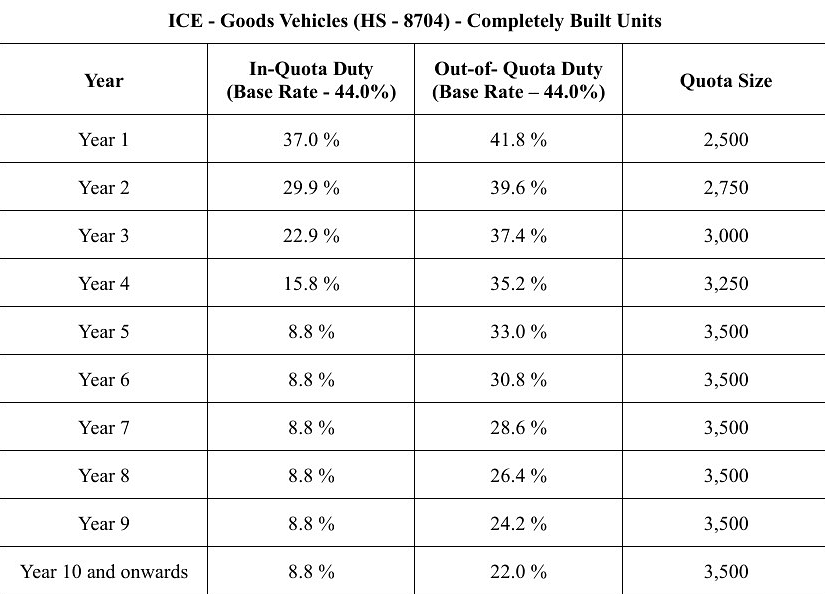
According to a document from the Ministry of Commerce, the current base rate of 44% on such imports will drop significantly to 8.8% within five years, provided the imports remain within defined annual quotas. This concessional tariff regime will be applicable to goods transport vehicles classified under HS Code 8704.
Tariff Reductions in Stages
In the first year of the agreement, the in-quota duty for UK-origin trucks will be reduced to 37%, covering up to 2,500 units annually. In the second year, the concessional rate will be further cut to 29.9%, with a slightly increased quota of 2,750 units. By the fifth year, the import duty will fall to 8.8%, with a quota of 3,500 units—a level that will remain constant from Year 5 through Year 10 and beyond.
Beyond Quotas
Notably, vehicles imported beyond the quota thresholds will continue to attract higher “out-of-quota” duties, though these too will be eased over time--from 41.8% in Year 1 to 22% by Year 10.
The gradual tariff reduction reflects the government's calibrated approach to balancing domestic manufacturing interests with trade liberalisation goals under its growing network of bilateral trade agreements.
“This TRQ (Tariff Rate Quota) mechanism could be a game changer for UK-based commercial vehicle OEMs seeking to penetrate or expand their presence in the Indian market. It also provides a framework for Indian logistics and fleet operators to access global vehicle technology with reduced landed costs over time,” said an analyst.
“However, it may also raise competitive pressures for domestic commercial vehicle manufacturers like Tata Motors, Ashok Leyland, and VE Commercial Vehicles, particularly in the higher-end or niche segments where imported trucks could offer advanced specifications,” the analyst added.

RELATED ARTICLES

BMW Expands MINI Retail Network in Navi Mumbai with Integrated Showroom
 Dev Vadchhedia
 29 Sep 2026
Dealer partner Infinity Cars to integrate BMW, MINI, and pre-owned BMW Premium Selection into a single Retail.NEXT showr...


FlixBus and Tourism Ministry Partner to Deploy Co-Branded Coaches and Promote Regional Travel
Dev Vadchhedia
29 Sep 2026
FlixBus signs pact to integrate Incredible India branding, launch destination portal, and initiate responsible travel ca...

Urban India's Consumer Confidence Rises to 66.9 in September: Ipsos Survey
 Shruti Shiraguppi
29 Sep 2026
Shruti Shiraguppi
29 Sep 2026
India's score is the highest among the 30 countries surveyed, while the global index held at 48.4.