Follow us
ICRA Tips 7–9% Highway Toll Growth Despite Construction Slowdown
India's highway toll collections are set for steady growth over the next two fiscal years, driven by stronger traffic and incremental toll rate revisions, even as road construction slows, according to ICRA.
 By Sarthak Mahajan
 718 Views


Highway toll collections across India's national highway network are on track for growth of 7–9% in FY2025-26, moderating to 6–8% in FY2026-27, credit ratings agency ICRA said on Wednesday, citing improving traffic volumes and inflation-linked toll rate adjustments as the primary growth drivers.
Traffic growth of 4–5% is expected to underpin revenue performance in the current fiscal year, a marked improvement over the 2.5% recorded in FY2024-25. However, toll rate hikes are likely to remain subdued in FY2026-27, with newer projects linked to December Wholesale Price Index (WPI) seeing increases of around 3.3%, while older projects linked to March WPI are expected to see hikes in the 2.5–3.0% range, reflecting soft inflation conditions.
Suprio Banerjee, Co-Group Head of Corporate Ratings at ICRA, noted that muted rate hikes would weigh on FY2026-27 collections, though buoyant economic activity should sustain traffic momentum. He also indicated that concerns around the annual FASTag pass scheme have had a limited impact on collections, with most developers now receiving weekly payouts from highway authorities, resolving earlier operational disruptions.
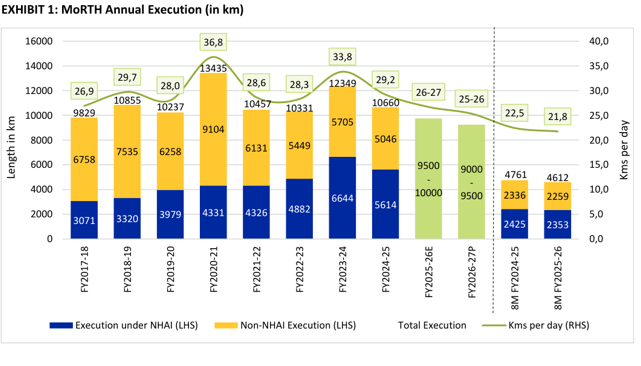
The positive revenue outlook comes against a backdrop of slowing road construction. ICRA expects MoRTH road execution to fall to 9,500–10,000 km in FY2025-26, down from 10,660 km in FY2024-25, declining further to 9,000–9,500 km in FY2026-27. Project awards are projected at 7,250–7,750 km in FY2025-26, broadly in line with the 7,538 km awarded the previous year but well below the levels seen between FY2020-21 and FY2022-23.
ICRA attributed the construction slowdown to a shrinking developer order book and disruptions caused by an early onset and elongated monsoon season. The agency noted a typical lag of six to nine months between project awarding and on-ground execution, suggesting that the pipeline slowdown will continue to constrain near-term activity. Nevertheless, the growing emphasis on expressways and high-speed corridors is expected to deliver relatively stronger growth in lane-kilometre expansion compared to overall construction volumes.

RELATED ARTICLES

Maruti Suzuki Projects Double-Digit Retail Growth Through Festive Season
 Autocar Professional Bureau
 21 Oct 2026
The carmaker reported a 35% increase in retail sales between Ganesh Chaturthi and Dussehra.


Valeo to Build NVIDIA Hyperion Compute Platforms for SDVs
 Dev Vadchhedia
21 Oct 2026
Dev Vadchhedia
21 Oct 2026
Valeo integrates dual NVIDIA DRIVE AGX Thor processors to produce Level 4 compute hardware for passenger cars, robotaxis...

Delhi CM Rekha Gupta Announces Anti-Pollution Measures: Non-BS VI Entry Ban, Mandatory Fuel Station PUC Checks
Autocar Professional Bureau
21 Oct 2026
Delhi mandates No PUC No Fuel policy, bars entry of non-BS VI vehicles, and implements staggered office hours and 50 per...