

 Follow us
Govt approves National Critical Minerals Mission with Rs 34,300 crore outlay
The government’s critical mineral list includes lithium, cobalt and nickel, and the new program aims to boost exploration, fast-track the approval process for critical mineral mining projects while offering incentives for mineral exploration.
 By Kiran Murali
 7494 Views


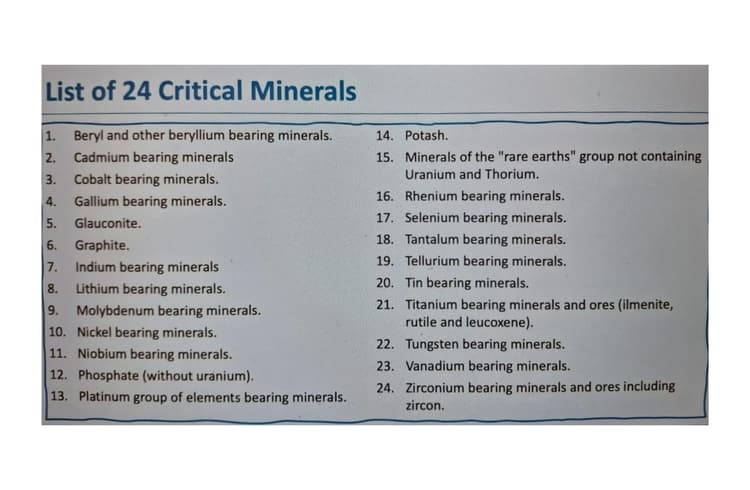
In a bid to reduce import dependency on critical minerals and boost exploration, the government approved the National Critical Minerals Mission on Wednesday with a total outlay of Rs 34,300 crore for the initial six years.
The program aims to increase exploration and develop technologies for processing and recycling, and reduce the import dependence of 24 identified critical minerals including lithium, cobalt and nickel. Government expenditure will be around Rs 16,300 crore while public sector companies are expected to invest Rs 18,000 crore.
“Green technologies such as solar panels, electric vehicles, wind turbines and batteries heavily rely on the use of critical minerals. They are essential for industries such as transport, high-tech electronics and telecommunications,” Union Minister Ashwini Vaishnaw told reporters today. “The mission will intensify the exploration of critical minerals within the country and in its offshore areas.”
He noted that the mission encompasses all stages of the value chain including mineral exploration, mining beneficiation, processing, and recovery from end-of-life products. The government will also fast-track the approval process for critical mineral mining projects while offering incentives for mineral exploration.
Currently, India's EV dreams are powered largely by imported batteries from China, Japan, and South Korea. Battery costs account for over 40% of the electric vehicle price. Localisation of cell manufacturing is something that is being looked at keenly as made-in-India Li-ion batteries hold immense potential to drive the adoption of EVs, besides making the country less import-dependent.
However, the biggest challenge for Li-ion battery manufacturing in India is the availability of raw materials. India lacks significant reserves of minerals such as Lithium, cobalt, nickel, and graphite. This forces battery makers to depend on imported raw materials.
India's lithium-ion battery industry heavily depends on imports, with China and Hong Kong being the primary suppliers. Currently, a significant part of Li-ion mineral production for cells is happening in China, thanks to the local government’s support in the form of cheap land, energy, trained labor, and less stringent environmental regulations.
While there have been discoveries of lithium deposits in Jharkhand, Rajasthan, and Jammu & Kashmir, India's efforts for domestic lithium mining and commercialization for battery production remain in state of infancy.
Heavy dependence on Chinese imports has the potential to create a supply chain bottleneck for the battery manufacturing industry in case of any geopolitical tension between the two countries.

RELATED ARTICLES

High-Tech Two-Wheelers Power EV Revenue Surge at Auto Parts Supplier Sona
 Shahkar Abidi
 26 Oct 2026
The automotive component maker expands two-wheeler EV portfolio, driving record quarterly revenue.


MoRTH Amends CMVR to Formalise E100, B100 Testing Norms; Raises Light-Vehicle Test Limit to 3,500 kg
Shahkar Abidi
26 Oct 2026
Gazette notification provides clear homologation roadmap for flex-fuel vehicles.

Amara Raja Appoints Preetam Ganguly as Chief Business Officer for Industrial Business
 Dev Vadchhedia
26 Oct 2026
Dev Vadchhedia
26 Oct 2026
The former Cummins India executive takes charge of industrial battery segment as part of a leadership succession plan.