Follow us
Daimler Truck Reports Lower Profits for 2025 as Markets Decline, but Orders Rise Heading Into 2026
The German commercial vehicle maker posted a 19% drop in adjusted earnings and a 10% fall in revenue for the full year, while order intake in the final quarter climbed 13%.
 By Angitha Suresh
 2123 Views


Daimler Truck Holding AG reported a decline in earnings and revenue for the 2025 financial year, as weaker demand across key markets and ongoing tariff pressures weighed on results. The company posted an adjusted Group EBIT of €3.78 billion, down from €4.67 billion in 2024, while Industrial Business revenue fell 10% to €45.9 billion from €50.7 billion. Earnings per share dropped to €2.56, compared with €3.64 the prior year. Adjusted return on sales for the Industrial Business came in at 7.8%, against 8.9% in 2024.
Total unit sales fell 8% to 422,510 trucks and buses worldwide. Free Cash Flow for the Industrial Business came in at €1.82 billion, against €3.15 billion in 2024. The company noted, however, that the fourth quarter showed a marked improvement, with cash generation reaching €1.75 billion in that period alone — a figure that management cited as evidence of the underlying financial discipline being applied across the business.
Despite the annual earnings decline, order intake showed signs of recovery. Incoming orders rose 2% for the full year to 425,458 units, compared with 417,131 in 2024. In the fourth quarter alone, orders increased 13% year-on-year, driven by a recovery in Mercedes-Benz Trucks and a partial rebound in North America. The company said it expects order momentum to carry through into the first half of 2026.
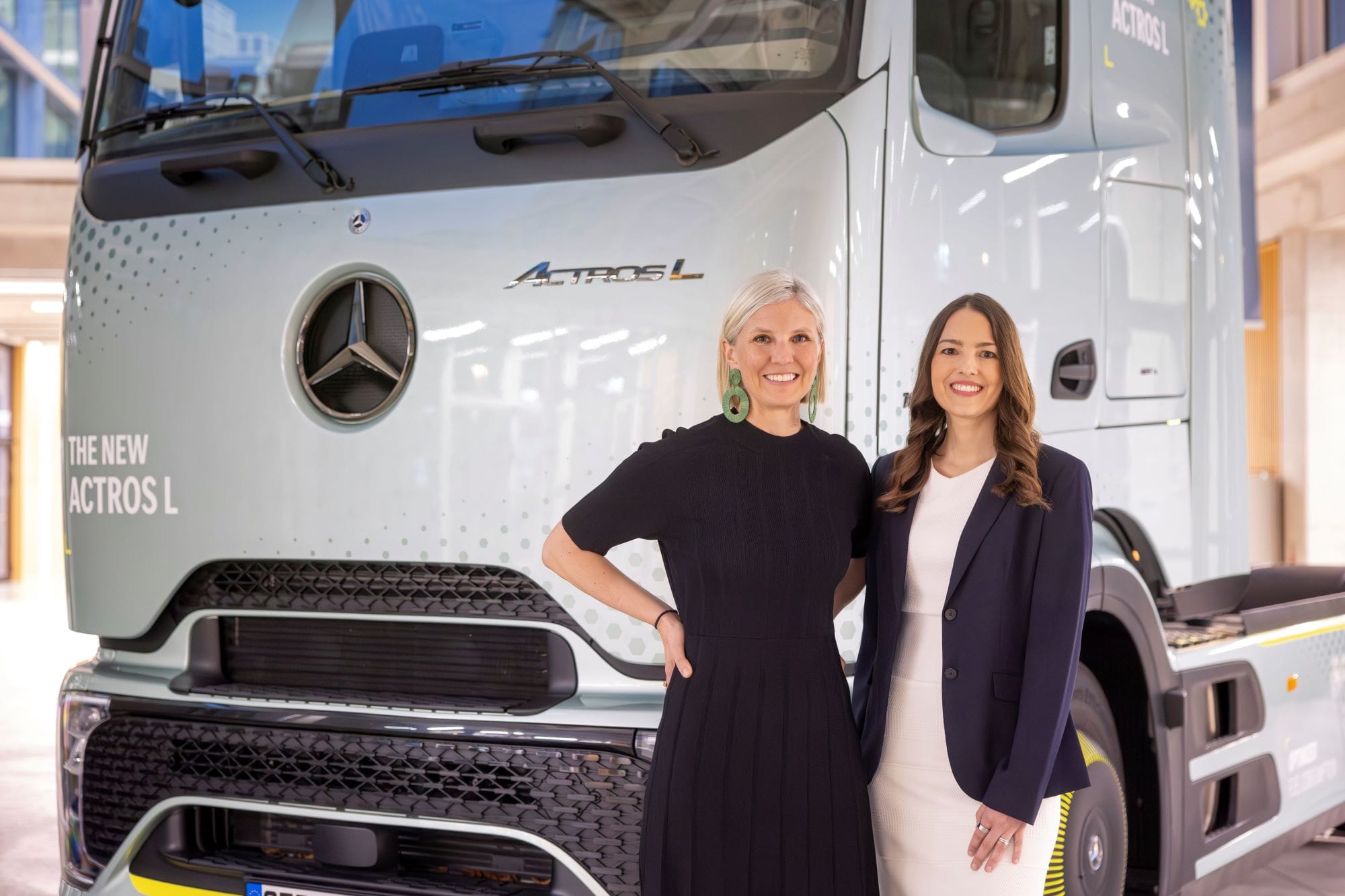 CEO Karin Rådström described the 2025 results as reflecting improved operational performance against a difficult backdrop. "We are market leaders in North America and Europe in medium- and heavy-duty trucks, reached double-digit profitability at Daimler Buses, and achieved significant order intake in the Defence business," she said, adding that efficiency measures were being executed ahead of plan.
Segment Performance
Trucks North America maintained its number-one position in the Class 8 segment, delivering what the company characterised as strong overall profitability despite a weak demand environment throughout the year and the effects of trade tariffs.
Mercedes-Benz Trucks posted solid profitability, supported by higher unit sales in Europe and the accelerated rollout of the Cost Down Europe efficiency programme. The programme delivered net savings of more than €100 million in 2025, exceeding original targets due to faster-than-planned execution. The company is targeting at least an additional €250 million in recurring net savings for 2026. Mercedes-Benz Trucks also regained market leadership in the EU30 region for medium- and heavy-duty trucks during the year. Trucks Asia delivered a robust performance, supported by positive unit sales in Indonesia and the Middle East.
Daimler Buses reported double-digit profitability for the first time in the segment's history, driven by a strong fourth-quarter result. The bus division also signed an agreement with Otokar to add manufacturing capacity for the Mercedes-Benz Conecto city bus to meet elevated demand.
Financial Services improved its return on equity through continued cost discipline.
Electric Vehicles and Technology
Battery-electric truck and bus sales rose 67% to 6,726 units in 2025, up from 4,035 units in 2024. Mercedes-Benz Trucks held a 35% share of the battery-electric medium- and heavy-duty truck segment across the EU30 region. Products including the Mercedes-Benz eCitaro city bus and the eActros 600 long-haul truck continued to perform in that segment.
At the same time, the company continued to develop diesel technology, citing diverse customer needs — particularly in markets where charging infrastructure remains limited. This dual approach underpins what Daimler Truck describes as a "speed of right" strategy, seeking to align the pace of transition with customer demand and infrastructure readiness rather than a fixed timeline.
Daimler Truck also launched Coretura, a joint venture with the Volvo Group, aimed at building a software-defined vehicle platform intended to serve as an industry standard for commercial vehicles.
Dividend, Buyback and Shareholder Returns
The Board of Management and Supervisory Board will propose a dividend of €1.90 per share for the 2025 financial year — unchanged from the prior year — at the Annual General Meeting on 6 May 2026. CFO Eva Scherer described the proposal as reflecting the company's strong balance sheet and a commitment to consistent shareholder returns. The company also confirmed it would initiate a previously announced share buyback programme in March 2026.
Outlook and Strategic Developments
For 2026, Daimler Truck forecast adjusted return on sales for the Industrial Business in a range of 6% to 8%, and Free Cash Flow between €2.7 billion and €3.2 billion. That Free Cash Flow figure includes an anticipated €1.5 billion cash inflow from the planned integration of Mitsubishi Fuso Truck and Bus Corporation and Hino Motors into a new joint holding company, ARCHION Corporation, to be established with Toyota Motor Corporation. The transaction is targeted to close on 1 April 2026, after which Mitsubishi Fuso will be deconsolidated from the Daimler Truck Group. Daimler Truck and Toyota each intend to hold a 25% stake in ARCHION, which is planned for listing on the Tokyo Stock Exchange.
Unit sales for 2026 are projected at between 330,000 and 360,000 units, compared with 315,000 in 2025 from continuing operations. Industrial Business revenue is estimated at between €42 billion and €46 billion. The company expects the second half of 2026 to be stronger than the first, reflecting anticipated volume recovery and the continued benefit of efficiency measures.
Scherer said that while tariff effects in 2026 would be "materially higher" than in 2025, volume growth and efficiency gains were expected to provide a substantial offset. The outlook assumes the current USMCA trade framework remains in place and does not account for potential supply chain disruptions or adverse macroeconomic effects stemming from the Middle East conflict.
Product Expansion and Defence
In North America, Daimler Truck began series production of the fifth-generation Freightliner Cascadia, the region's leading Class 8 truck by sales volume. In Latin America, the company introduced the all-new Mercedes-Benz Axor, a heavy-duty vehicle rated for up to 68 tonnes. In India, it expanded its BharatBenz range with new models targeting the construction and mining sectors, with a stated intention to use domestic volume as a foundation for future export growth.
On the defence side, the company secured a contract for 7,000 Mercedes-Benz Zetros military trucks for the French Army. Defence revenue is now expected to reach €1 billion by 2028, two years ahead of an earlier target of 2030 that was set at a prior Capital Markets Day.
The company also expanded its own retail network in Europe and opened a new Global Parts Centre in Halberstadt, Germany, capable of delivering approximately 300,000 parts to dealers in more than 170 countries.
Daimler Truck Holding AG, listed on Germany's DAX index, is one of the world's largest manufacturers of commercial vehicles, with more than 100,000 employees across over 40 locations globally. The company operates brands including Freightliner and Western Star in North America, Mercedes-Benz Trucks and Setra buses in Europe, and FUSO and BharatBenz in Asia. It was spun off from Daimler AG and listed independently on the Frankfurt Stock Exchange in December 2021.
The commercial vehicle sector has faced a period of adjustment following a period of elevated demand in 2023 and early 2024, driven partly by fleet replacement cycles and post-pandemic freight growth. Slowing freight volumes, rising interest rates affecting fleet financing, and uncertainty over trade policy — particularly around US tariffs — contributed to a softer market environment in 2025. Against that backdrop, the 2025 results landed within the guidance range the company had set at the start of the year.

RELATED ARTICLES

Volvo Cars names Skoda’s Klaus Zellmer as new president, CEO
 Autocar Professional Bureau
 20 Sep 2026
Zellmer will take the new role in October 2027.


Volvo’s 20:1 Compression Ratio Breakthrough: How Dual-Wave Pistons Could Deliver 4% Fuel Savings for Indian Fleets
 Shahkar Abidi
20 Sep 2026
Shahkar Abidi
20 Sep 2026
A decade after its engineers reshaped the piston crown and halved diesel soot, Volvo has doubled down, on the design at ...

Weekly News Wrap: Record Auto Sales Spur Production Push, Fresh Investments
 Darshan Nakhwa
20 Sep 2026
Darshan Nakhwa
20 Sep 2026
The week saw Kia and Hyundai raise production on strong demand, passenger vehicle and scooter volumes hSemiit fresh hig...