



 Follow us
Carmakers Risk Losing Their Products’ Soul Without Software Control: Synopsys
Synopsys' Dr Ravi Subramanian says OEMs are taking greater control of software and computing as software-defined vehicles reshape engineering roles and supplier relationships.
 By Mukul Yudhveer Singh
 1 Views


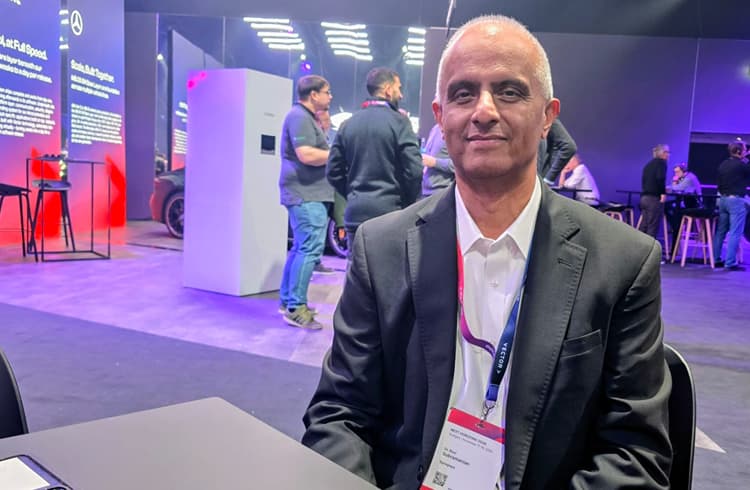
Automotive manufacturers are increasingly bringing software integration in-house, a responsibility traditionally entrusted to Tier 1 suppliers, according to Dr Ravi Subramanian, Chief Product Management Officer at Synopsys. Some are going a step further by taking ownership of software development itself, recognising its growing contribution to vehicle functionality and product differentiation. The transition towards software-defined vehicles (SDVs) is consequently changing the distribution of engineering responsibilities across the automotive supply chain.
Speaking exclusively to Autocar Professional on the sidelines of Vector NEXT HORIZONS 2026 in Stuttgart, Germany, Subramanian said retaining control over software is becoming increasingly important for automotive OEMs. “Some are even bringing software development in-house completely because they understand the value of the product they're building is all in that. If they give that away, you've just given away the soul of the product,” he said.
Subramanian believes automotive manufacturers are at different stages of their transition towards SDVs, with the pace of adoption varying across companies. The fundamental shift involves moving away from developing a vehicle with software to allowing software to define the vehicle itself.
“Most of them understand that they can't think about it as a car with software,” he said.
The growing involvement of OEMs in software development does not necessarily diminish the role of technology suppliers. Companies such as Synopsys are being asked to undertake responsibilities that extend beyond their traditional areas of expertise, altering the conventional division of work between manufacturers and suppliers.
“OEMs expect us to do more. We will do more, but it's a very different world,” he said. Referring to the responsibilities previously handled by Tier 1 suppliers, he added, “So it's a rearranging of who is doing what.”
Synopsys, whose capabilities in semiconductor design have been complemented by its acquisition of simulation specialist Ansys, is working with Vector to bring electronic digital twins and software development workflows together. The collaboration combines Synopsys' electronic digital twin capabilities with Vector Flow, enabling continuous software development and integration alongside virtual representations of the underlying electronics. Subramanian said automotive manufacturers themselves are encouraging technology companies to collaborate and deliver such integrated engineering solutions.
“That's something that Tier 1 would have never done themselves,” he said, referring to the combined capabilities of Synopsys and Vector. Neither company, he explained, could independently provide the entire solution. “Customers are forcing us. They want to see this.”
The commercial opportunity for engineering technology providers extends well beyond automotive. During his keynote at Vector NEXT HORIZONS 2026, Subramanian estimated that approximately $1.7 trillion is spent globally on research and development of physical products, with 90% going towards building and testing. The remaining 10%, equivalent to around $170 billion, is directed towards virtualisation and digital engineering, an area he said is growing rapidly.
In his exclusive interaction with Autocar Professional, Subramanian identified software factories and digital twins as two proven methods of reducing development and testing timelines.
“Absolutely are proven methods to reduce cycle time. That reduces development time, and it really reduces testing time,” he said, referring to the two technologies.
He said some companies are already reporting that they have halved their development cycle times, while others are adopting common software development and testing processes across their suppliers. Some companies are also targeting the virtualisation of 50% of their physical tests, a transition he estimated would typically take three years.
“Physical testing will never go away. Physical testing will be there because it is the final confidence builder for teams,” he said.
The economics of virtual validation are becoming increasingly attractive as computing costs decline. Unlike physical testing, virtual validation can also begin before a physical prototype becomes available, reducing the time spent waiting for hardware.
During his keynote, Subramanian cautioned against deploying AI across disconnected engineering workflows. Companies seeking to accelerate product development through AI could end up increasing fragmentation if their engineering processes and data remain disconnected.
“We need to connect before we automate,” he said.
Subramanian also advocated prioritising investments in shared virtual engineering platforms over individual engineering tools during his keynote.
“A shared platform will optimise end-to-end performance,” he said.
He called for common data, model and interface standards across engineering departments, alongside individual accountability for the entire engineering workflow. Performance incentives, he suggested, should reward improvements in overall development speed and quality rather than outcomes achieved by individual engineering functions.
Software development is also influencing how automotive manufacturers approach semiconductor investments. The growing computing requirements of AI-enabled vehicle functions are encouraging OEMs to pay greater attention to the processors that will underpin future vehicle architectures. In his exclusive interaction, Subramanian said automotive companies would seek greater control over their computing requirements alongside the software that runs on these platforms.
“More and more car companies have a compute roadmap. They never had one five years ago,” he said.
Subramanian expects more partnerships between automotive and semiconductor companies as the industry looks towards computing solutions tailored to vehicle applications. Advances in low-power inference chips are enabling more AI-related processing to take place within the vehicle itself, reducing the amount of data that needs to be transmitted externally.
Alongside software integration and computing architectures, Subramanian identified specialised engineering expertise as another capability that automotive manufacturers must preserve. He believes companies have an opportunity to digitise the domain-specific skills accumulated by their engineers and make them available across their organisations through AI agents.
“The skills are what you do with that knowledge,” he said. “You want to capture as much of the skills you have into a digital world. So more people in the company can exploit it.”
During his keynote, Subramanian also emphasised that Synopsys and Vector view AI as a means of enhancing engineering capabilities rather than replacing engineers.
“It is not gonna take away engineering jobs. It is going to redefine engineering, but it will make engineers far more productive,” he said.
In his exclusive interaction, Subramanian drew parallels with the semiconductor industry, where engineers are already using AI agents to assist with complex engineering tasks. Automotive companies could adopt similar practices across disciplines, including specialised functions such as lighting optimisation.
“Companies will have their own agents. They'll buy agents from others. And they will have a mix of agents to help their engineers,” he said.

RELATED ARTICLES

BYD Enters Exclusive Talks to Acquire Hambach Plant in France
 Eshisha Java
 25 Nov 2026
BYD has entered exclusive talks to acquire Ineos Automotive's Hambach plant in France, potentially expanding its Europea...


Rajratan Global Wire Board Approves Netherlands Subsidiary, Plans €50,000 Investment
Eshisha Java
25 Nov 2026
Rajratan Global Wire will establish a wholly owned subsidiary in the Netherlands under the proposed name Rajratan Wire E...

MMCM Launches MottoFlip Platform For Vehicle Scrapping
Eshisha Java
25 Nov 2026
New digital platform connects vehicle owners with authorised Registered Vehicle Scrapping Facilities (RVSFs), aiming to ...

