



 Follow us
Bound Digital, Scale Armed: Inside Agratas’ Dual-Continent Battery Blueprint
Tata's battery arm is combining zero-‘shadow IT’ plant architecture across Sanand and Somerset, indigenous battery chemistries, and bidirectional BMS telematics to secure EV cell sovereignty.
 By Shahkar Abidi
 1 Views


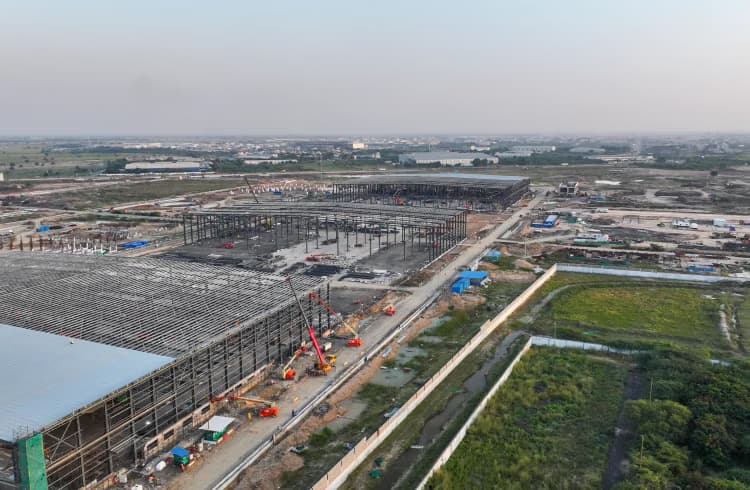
As equipment installation accelerates at Sanand (Gujarat) and Bridgwater, Somerset, ahead of major manufacturing readiness and system commissioning milestones, Tata’s battery manufacturing arm, Agratas, is reaching a critical industrial inflection point. With anchor production commitments for Jaguar Land Rover (JLR) and Tata Motors' mass vehicles in India looming, the greenfield cell producer is racing to establish a dual-continent footprint capable of rivaling incumbent battery giants.
"Our intent is that we digitize processes, but we get data out of it; that is driving insights and intelligence for us, right from day one." Sreeji Kumar, Chief Digital & Information Officer at Tata Agratas, said. Kumar has over 25 years of experience in spearheading greenfield and digital transformations for renowned global firms, such as Stellantis and Honeywell.

Sreeji Kumar, Chief Digital & Information Officer, Tata Agratas
The development at Agratas should be seen in the context of the Indian government pushing to make battery manufacturing including the cells more localized as headwinds from geopolitics often loom. Among the first initiatives introduced is the Rs 18,100 Crore ACC PLI Scheme which incentivizes domestic cell manufacturing. It mandates strict Domestic Value Addition (DVA)—requiring companies to achieve 25% local value addition within two years and 60% within five years. Phased manufacturing programs apply basic customs duties on imported battery packs and cells to protect early-stage domestic gigafactories from cheap foreign imports. Furthermore, government subsidies for electric 2-wheelers, 3-wheelers, 4-wheelers, and commercial buses are ensuring high local demand for battery packs produced in India.
In this scenario, Agratas is competing against both domestic conglomerates and established East Asian battery giants including Reliance, Ola, Exide, Amara Raja. The foreign players include CATL & BYD (China), LG Energy Solution & Samsung SDI (South Korea), and Panasonic (Japan), which currently supply the vast majority of cells imported into India.
Critics argue that current initiatives for developing cell technologies in India remain inadequate, with an urgent need for similar incentives for the component supplying industry to cell manufacturing, which is not yet developed.
Parallel Architecture and Zero 'Shadow IT'
As per the company officials, operating on a clean slate, Agratas has deployed an identical Manufacturing Execution System (MES), SCADA framework, and Operational Technology (OT) aggregator across both its Indian and British facilities.
The company's overall total expenses reached around Rs 1144 crore during FY26. However, its assets more than doubled to Rs 14,515.93 crore during the same period. Tata Sons Private Limited holds 88% of the issued share capital, while AESC Apollo Holdings Limited holds 12% in Agratas as per is latest financial filing for FY26. Agratas received Rs 186.21 crore in engineering and tech services from AESC Apollo Holding Limited (recognized in profit & loss and CWIP), alongside sample cell purchases from AESC Jiangsu Co Ltd.
Execution of capital works at the gigafactories relies heavily on Tata Group companies. Capital services provided by Tata Projects Limited surged to Rs 824.29 crore in FY 2025–26 (up from Rs 119.30 crore in FY 2024–25). Additional capital and IT work was executed via Tata Consulting Engineers, Tata Elxsi, Tata Communications, and others.
This architectural mirroring extends directly to the company's research and development hubs. R&D operations in Bengaluru focus on Lithium Iron Phosphate (LFP) chemistry tailored for mass-market vehicles, while the Oxford lab advances Nickel Manganese Cobalt (NMC) formulations primarily serving JLR's luxury portfolio. By standardizing the IT and OT infrastructure across both continents, Agratas enables direct cross-plant yield benchmarking and frictionless technology transfer from lab scale to high-volume production.
"Anything and everything connecting to a machine, whether it is an R&D network, manufacturing network, or an enterprise network, is owned by my team. The same set of manufacturing execution systems what we deploy in Sanand will be the same which will be deployed in Somerset. Consistency is the name of the game.” he explained.
Indigenous IP and Powder-Level Sourcing
Importantly, rather than relying entirely on licensed foreign technology, Agratas made a strategic decision to engineer its own indigenous intellectual property, the top executive claims.
To execute this transition without compromising cell stability or safety, Agratas established advanced testing labs and pilot lines capable of validating raw materials down to the 'powder level'. To bypass localized talent bottlenecks, the company recruited experts across 30 different nationalities and forged channel partnerships with suppliers in neutral geographies to secure ethically sourced, fully traceable precursor chemicals.
“The journey to becoming indigenous is going to be a good, challenging one. We are hiring where the right talent is; that's why we’ve ended up with 30 different nationalities in the company today. We have the ability to evaluate materials at a powder level, or at various building-block levels, supported by our R&D labs and pilot centers, while insisting on ethical sourcing and complete traceability.” Kumar further added.
Operator Augmentation Over 'Lights-Out' Hype
While narrative trends in industrial tech often highlight fully autonomous 'lights-out' factories, Agratas argued that it is taking a structured, multi-phase approach to shop-floor automation. The company translates Design Failure Mode and Effects Analysis (DFMEA) into Production FMEA (PFMEA), establishing strict control plans for critical variables such as ambient humidity, slurry coating temperature, and chemical recipe limits.
Edge computing systems monitor these parameter bounds in real time, issuing proactive alerts to shop-floor technicians before micro-defects occur. Closed-loop autonomous factory adjustments are explicitly targeted as a three-to-five-year milestone, allowing operational AI models time to mature against comprehensive physical data sets.
“We are starting by creating alerts to the operator, saying, 'You are going out of bounds on your control limits, and now you need to make adjustments'. We are not going to build a closed-loop system at this point in time because you need a lot of data. Long-term, we will get to a closed-loop AI-driven factory—maybe three to five years down the line.” Kumar remarked.
Linking In-Vehicle Performance to Cell Economics
Agratas’ digital thread operates through contractual data-sharing agreements with OEM partners, cell tracking incorporates a bidirectional feedback loop between the factory floor and vehicles operating in the field, the company adds.
Forward data flows capture raw material provenance, SCADA processing metrics, and testing records to populate a digital Battery Passport. In reverse, live in-vehicle Battery Management System (BMS) telemetry reports real-world thermal stress, degradation rates, and discharge profiles back to R&D teams. This live field data allows chemical engineers to calibrate the exact volume of active material required in future cell iterations—directly reducing cell production costs while maintaining rigorous safety standards.
“It brings in connectivity and linkage to how the cells perform in the vehicle via its BMS system. That reverse connection is going to help us once we launch, so that we know what we produce, how it really performs in the field, and what active material we put into that cell.” he further explains.
Cell Standardization as a Competitive Lever
As the wider EV sector debates complex structural integration trends—such as 800V+ high-voltage architectures, cell-to-pack, and cell-to-chassis designs—Agratas is concentrating its engineering capital on cell capacity standardization. Sreeji Kumar notes that spreading engineering focus across niche pack architectures risks diluting execution and undermining manufacturing scale.
“Our interest is to standardize on certain capacity cells rather than spreading our focus to different technologies. Deployment is not the measure of success for me. Adoption is the measure of success. Yield is the measure of success. Quality is the measure of success.” Kumar noted before signing off.

RELATED ARTICLES

Shivam Autotech Q2 Net Loss Widens to Rs 13.8 Crore
 Dev Vadchhedia
 04 Nov 2026
While loss improves sequentially compared to Rs 20.99 crore, and revenue increases, pressure remains due to elevated raw...


Kirloskar Oil Engines Q2 Net Profit Drops 18 Percent to Rs 130 Crore
Dev Vadchhedia
04 Nov 2026
Higher raw material compress margins despite robust engine sales across B2B segments.

Varroc Engineering Q2 Profit Drops 47% Despite Record Revenue
Dev Vadchhedia
04 Nov 2026
Record quarterly revenues and 54 percent growth in pre-tax profit offset by exceptional charges for Italian plant reloca...

