Follow us
Apollo Tyres inaugurates Advanced R&D Tyre Testing facility
Facility to reduce the new product development cycle time for the company.
 4985 Views


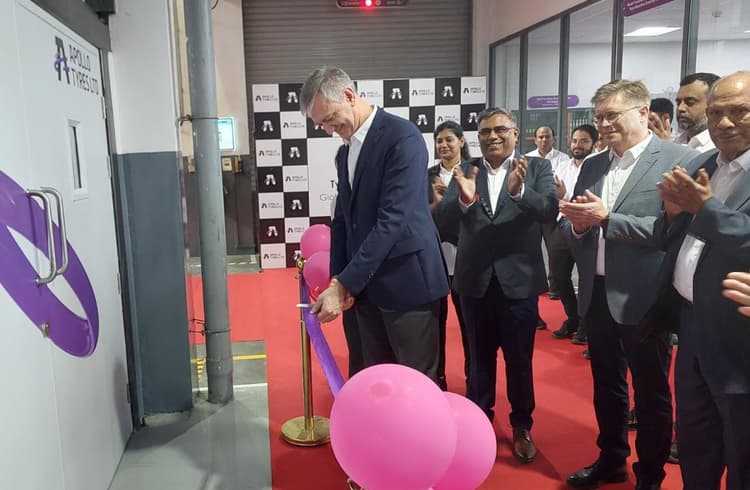
Apollo Tyres, the leading tyre maker, today inaugurated an Advanced Tyre Testing facility, which is housed at its Global R&D Centre, Asia in Chennai, India. The new facility will help improve upon the efficiency and effectiveness of the product development cycle for passenger vehicle and two-wheeler tyres, including the ones for electric vehicles.
The key features of the Advanced Test facility are the custom-designed Flat-trac machine and Anechoic Chamber, which would characterise the performance of tyres’ dynamics and acoustics, leading to faster product development for both OE and Replacement markets. The development of tyres for high-end passenger vehicles, EV specific tyres for PV and high-end motorcycle tyres would be the products that would get directly benefited due to this facility.
Speaking at the inauguration, Daniele Lorenzetti, Chief Technology Officer, Apollo Tyres, said “We strongly focus on continuous improvement in efficiency and effectiveness of product development, and this new facility will further augment our testing capabilities for future vehicle models. We will be able to fine tune the performance of our products by simulating closely to the real-world conditions using this facility. This is aligned with Apollo Tyres’ 2026 vision, of which Technology is a key pillar.”
The Flat-trac machine, which is a key component of Advanced Tyre Testing, is used to characterise handling parameters and tyre models, measuring force and moment (F&M) properties of tyres, as per vehicle’s improved dynamics. This machine is custom designed to address tyre simulation needs of future vehicles, such as EVs and autonomous vehicles. Unlike previous versions, this machine replicates real-life situations, including emergency manoeuvres of vehicles like high slip angles and high torque ramp-up. For two-wheelers, it simulates the most severe inclinations, as prevalent amongst premium motorcycle riders.
Another component of this testing facility is the High-Speed Uniformity machine combined with Anechoic Chamber. This helps simulate the NVH (Noise, Vibration and Harshness) properties of the tyres, which are critical for vehicles, especially EVs and premium vehicles. This machine combines the study of both mechanical and acoustic comfort parameters, by building different road profiles for the tyres to be tested.
Apollo Tyres is also looking at reducing the expensive and time-consuming tests at different tracks around the world, by augmenting the advanced testing capabilities.

RELATED ARTICLES

Hyundai Targets 2.5 Lakh Creta, Bayon Sales to Defend Monocoque SUV Leadership
 Autocar Professional Bureau
 26 Oct 2026
The Bayon gives Hyundai a second offering against Maruti Suzuki, Kia, Toyota and Tata in the expanding monocoque mid-siz...


AIDA Eyes E30, Flex-Fuel Vehicles to Drive Next Phase of Ethanol Growth
 Mukul Yudhveer Singh
26 Oct 2026
Mukul Yudhveer Singh
26 Oct 2026
With E20 blending achieved, the distillers' association is advocating higher ethanol consumption through flex-fuel vehic...

Honda Considers Motocross and Enduro Bikes for India
 Autocar India
26 Oct 2026
Autocar India
26 Oct 2026
Honda is considering expanding its off-road motorcycle range in India, with potential additions spanning motocross and e...