

 Follow us
China's Shenzhen becomes world's first city to electrify entire 16,359-strong bus fleet
In 2017, the Chinese government offered 3.3 billion yuan (Rs 3,359 crore) in subsidies for adoption of e-buses and construction of charging facilities.
 By Autocar Professional Bureau
 16594 Views


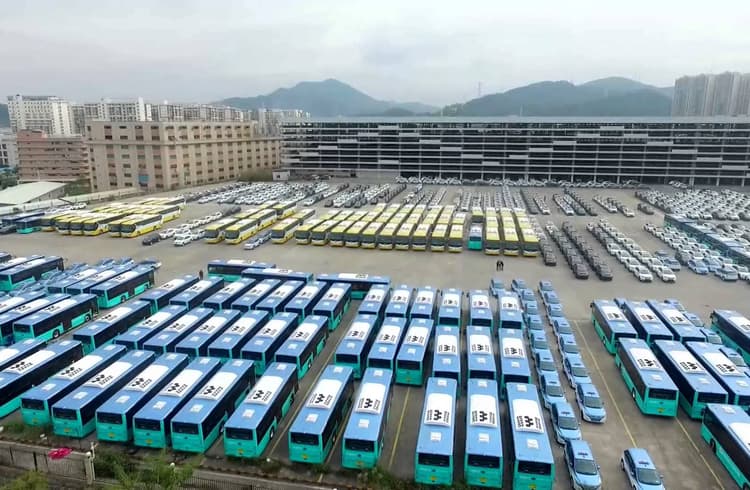
Even as the pace of electromobility picks up pace, China, the world's largest market for electrified vehicles, is going places. The country, with its huge population and home to global manufacturing activities, has battled high levels of pollution since long and is now taking concrete steps to reduce CO2 levels across its cities. One such example is the city of Shenzhen, which has made all of its public transportation completely electric.
Shenzhen is a major financial centre in southern China with a population size of 10,357,938 (China 2010 census). The city saw a major economic turnaround when it was promoted to city status in 1979 and became the first hub for China’s Special Economic Zone (SEZ). Shenzhen is also a leading automotive hub to major OEMs and component suppliers with BYD Auto, one of the world's largest electric vehicle manufacturers, being based there.
Now Shenzhen has become the world's first city to electrify 100 percent of its public transit bus fleet, as per the city's transport commission. The city is also home to the largest fleet of electric buses – 16,359 so far – and electric taxis in the world (total of 12,518 taxis, or 62.5 percent of all taxis in the city).
"We will gradually replace the existing fuel-powered cabs with electricity-powered ones and complete the target by 2020, or even ahead of schedule," said Zheng Jingyu, head of the public transport department of the city's public transport administration bureau.
According to the Chinese government in 2018, the remaining of 500 green cabs that are restricted from Futian, Luohu, Nanshan and Yantian districts, which constituted the former Shenzhen Special Economic Zone, will be replaced with electric cabs and be allowed to operate citywide.
501 bus charging stations
For powering the needs of its public transport model, the city has built 501 bus charging stations that is equipped with 8,000 charging poles.
"A bus can be fully charged within two hours and the charging poles can serve 300 buses a day. Since the replacement, the bus terminal has become quiet, even when the e-buses enter and exit the terminal, "said Guan Anguang, assistant manager of Qinghu Bus Terminal.
Video courtesy BYD
Lou Heru, vice-head of the city’s transport commission, said, "The wide use of electric buses and cabs plays a significant role in improving air quality and constructing a beautiful Shenzhen."
In an official statement, the Shenzhen government said the switch to electric buses has reduced energy consumption by around 72.9 percent compared to the diesel buses. It claims that in a year, the buses could save the energy equivalent of 366,000 tonnes of standard coal, replacing 345,000 tonnes of fuel, and reducing carbon dioxide emissions by 1.35 million tonnes. The e-taxis will save the energy equivalent of 119,000 tonnes of standard coal, replacing 116,000 tonnes of fuel.
The government chose Shenzhen in 2009 as one of the 13 cities to pilot a national new-energy vehicle program. In 2017, the city offered 3.3 billion yuan (Rs 3,359 crore) in susidies for e-buses and the construction of charging facilities. The city also encourages cab operators and private investors to invest in charging poles and stations for e-taxis.

RELATED ARTICLES

Horse Powertrain develops ‘all-in-one’ powertrain for hybridizing BEV platforms
 Ajit Dalvi
 20 Apr 2026
X-Range C15 Direct Drive is an ‘all-in-one’ hybrid powertrain that allows BEV platforms to serve as foundations for HEVs...


Autoliv Plans JV for Advanced Safety Electronics With China’s HSAE
Ajit Dalvi
11 Oct 2025
The new joint venture, which is to be located strategically near Shanghai and close to several existing Autoliv sites in...

JLR to Restart Production Over a Month After September Hacking
Ajit Dalvi
07 Oct 2025
Manufacturing operations at the Tata Group-owned British luxury car and SUV manufacturer were shut down following a cybe...