
 Follow us
GM and NASA’s RoboGlove could see industrial scale use
Robotic glove technology developed out of a partnership between General Motors and NASA for use on the International Space Station is being brought to life in health care, manufacturing and other applications.
 By Autocar Professional Bureau
 3731 Views


Robotic glove technology developed out of a partnership between General Motors and NASA for use on the International Space Station is being brought to life in health care, manufacturing and other applications though a licensing agreement between GM and Bioservo Technologies AB, a Swedish medical technology company.
Working with GM, Bioservo will combine technology from its SEM Glove (Soft Extra Muscle) technology with the RoboGlove, a force-multiplying wearable developed during GM and NASA’s nine-year collaboration that included the launch of Robonaut 2 (R2), a humanoid robot, into space in 2011.
The RoboGlove uses leading-edge sensors, actuators and tendons that are comparable to the nerves, muscles and tendons in a human hand. One design requirement for R2 was to operate tools designed for humans, and developers achieved unprecedented hand dexterity. That technology was applied to the RoboGlove.
Bioservo will initially develop a new grasp assist device for industrial use that could increase efficiency while reducing fatigue in hand muscles. Research shows fatigue can occur within a few minutes of continuously gripping a tool.
GM to test RoboGlove in some automobile plants
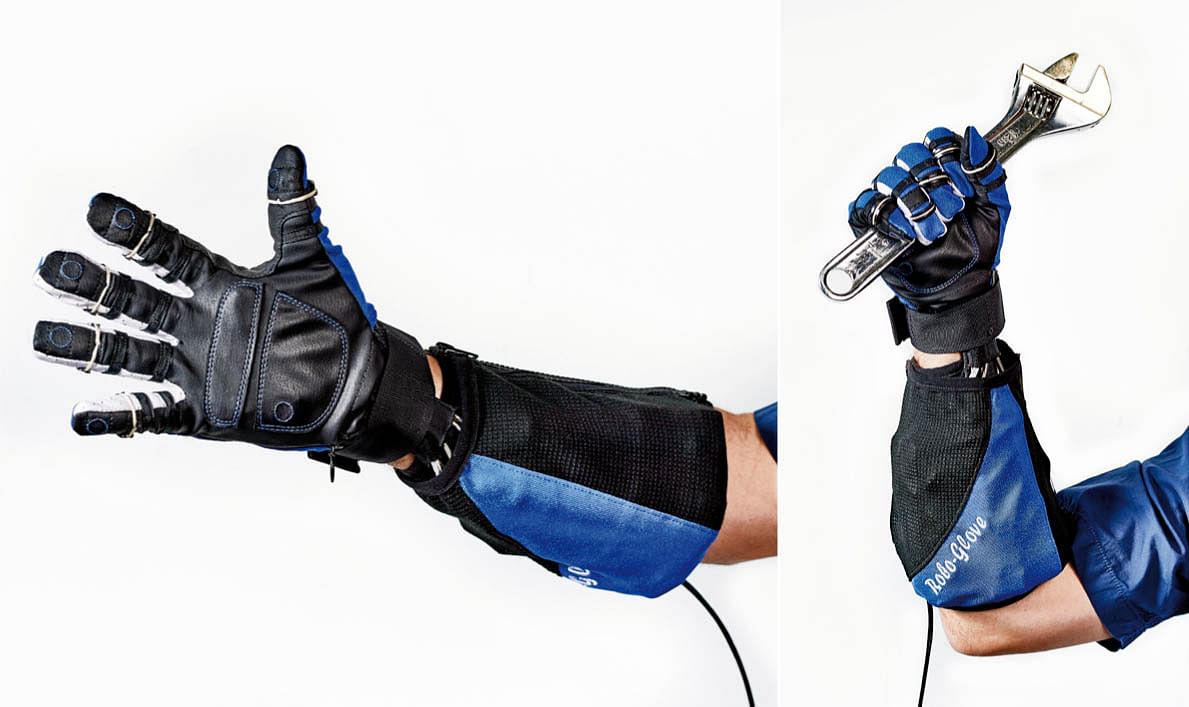
“Combining the best of three worlds – space technology from NASA, engineering from GM and medtech from Bioservo – in a new industrial glove could lead to industrial scale use of the technology,” said Tomas Ward, CEO of Bioservo Technologies.
Ward described the technology combination as a major step toward introducing soft exoskeleton technology globally.
GM intends to be the first U.S. manufacturing customer for the refined robotic glove and will test it in some of its plants. Bioservo will make and sell the new glove for a variety of uses including medical rehabilitation and any place additional gripping strength is needed.
“The successor to RoboGlove can reduce the amount of force that a worker needs to exert when operating a tool for an extended time or with repetitive motions,” said Kurt Wiese, vice-president of GM Global Manufacturing Engineering.
GM briefly tested RoboGlove in a preproduction plant before looking for a partner to help refine it to fit different size hands and address other issues.
Financial details of the license granted to Bioservo by GM, NASA and Oceaneering International Inc were not disclosed.

RELATED ARTICLES

Horse Powertrain develops ‘all-in-one’ powertrain for hybridizing BEV platforms
 Ajit Dalvi
 20 Apr 2026
X-Range C15 Direct Drive is an ‘all-in-one’ hybrid powertrain that allows BEV platforms to serve as foundations for HEVs...


Autoliv Plans JV for Advanced Safety Electronics With China’s HSAE
Ajit Dalvi
11 Oct 2025
The new joint venture, which is to be located strategically near Shanghai and close to several existing Autoliv sites in...

JLR to Restart Production Over a Month After September Hacking
Ajit Dalvi
07 Oct 2025
Manufacturing operations at the Tata Group-owned British luxury car and SUV manufacturer were shut down following a cybe...