


 Follow us
Tech Talk: the future of in-car stereo
Electrostatic speakers are not only sought after for their clarity, but they can save weight and space for car designers.
 04 Nov 2022
 7965 Views
Share -
7965 Views
Share -


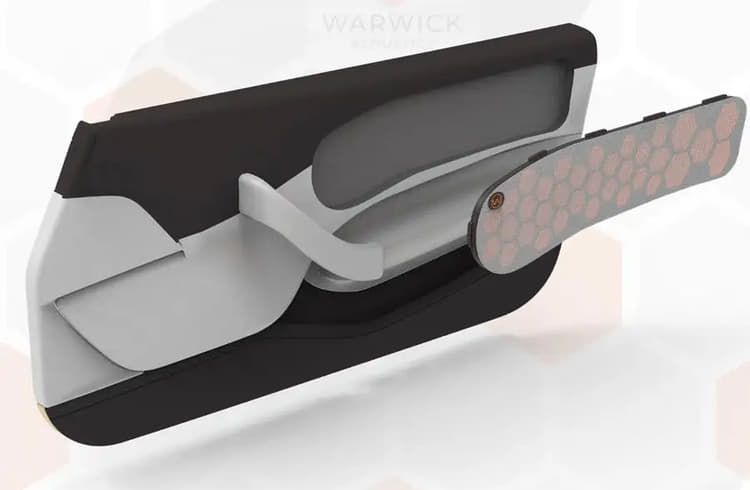
Developed by Warwick Acoustics, the speaker weighs 75% less and consumes 90% less power than a conventional set-up.
In the world of hi-fi, electrostatic speakers have been a thing for decades and are sought after for their clarity and low distortion compared with conventional cone speakers. Now Warwick Acoustics has incorporated the technology into car interior panels, thereby saving space, weight and energy consumption.
Its Electroacoustic panels are made, it says, entirely from up-cycled or recyclable materials and are free of rare-earth metals (in the form of, say, neodymium magnets).
The basic technology of the electrostatic speaker lends itself to being incorporated into panels and surfaces because instead of being based on bulky cones backed by magnets, they take the form of flat sheets.
A conventional speaker consists of a cone attached to a transducer, a device that converts energy from one form to another – in this case, electricity to sound.
The transducer is more commonly called the driver. It consists of a permanent magnet and an electromagnetic moving coil called the voice coil. This moves when an electrical signal from the amplifier passes through it, and since the cone (properly called the diaphragm) is attached to it, that moves as well, prodding the surrounding air and thus making the sound we hear.
It’s the permanent magnet that may be made using rare-earth metals in order to reduce weight. They’re also more powerful than conventional iron magnets.
An electrostatic speaker is quite different. Imagine three thin sheets hanging close to one another, like a sandwich. The central sheet carries an electrical charge and the amplifier signal passes into the electrically conductive sheets flanking it (these are called stators because they stay stationary). In response, the central sheet moves like the cone in a conventional speaker and vibrates the air, generating sound.
In the case of Warwick Acoustics’ in-car solution, the moving membrane that does the hard work is a mere 0.015mm thick – almost five times thinner than a human hair. This is where one of the advantages of an electrostatic speaker comes into play: it has very little mass, making it easy to move and respond instantly to the amplifier’s signal. A moving-coil speaker, on the other hand, has relatively heavy moving parts, and moving them involves overcoming inertia.
Warwick Acoustics’ Electroacoustic panels have been 10 years in development, and the technology in them is derived from the electrostatic transducers that the firm developed for its headphones. The panels consist of Warwick Acoustics’ Electro Static Transducers (EST) and a specially designed Electronics Drive Module. The EST is stretched across open cell (honeycomb) spacers, creating small, individual drums that transmit sound. The shape, size and distribution of the cells influence the frequency response (the frequency of sound, from bass to treble) and the direction in which the sound is aimed.
It looks like a neat solution that covers the bases of sustainability, weight and energy consumption (and therefore CO2 reduction) – and, if it performs as well as its maker claims, produces premium sound quality too.

RELATED ARTICLES

The Man Who Steers Nine Out of Ten Cars
 Autocar Professional Bureau
19 Oct 2026
Autocar Professional Bureau
19 Oct 2026
How two quiet, fifty-year-old family suppliers, forging fifty million steering yokes a year for nine out of ten cars in ...


Inside India's ₹20-Lakh-Crore Auto Loan Boom
 Anurag Chaturvedi
18 Oct 2026
Anurag Chaturvedi
18 Oct 2026
Delinquencies are at multi-year lows, but there's no visibility on whether borrowers earn enough to service the debt.

Eicher Bets ‘De-Skilling’ Diagnostics Will Hook India’s Small Truck Fleets
 Shahkar Abidi
14 Oct 2026
Shahkar Abidi
14 Oct 2026
Commercial vehicle maker aims to double parts revenue to Rs 5,000 crore by automating diagnostic and warehouse operation...