Follow us
AFFORDABILITY: How GST Cuts Reshaped India's Sub-4m Market
Taken together, Mini, Compact, and sub-4m SUV segments have moved to a materially higher demand level — and the shift appears to be holding.
 By Angitha Suresh
 1660 Views


The Mini segment’s doubling, as dramatic as it is, represents a relatively small volume in absolute terms. The more consequential question is whether the GST cut had a measurable impact across the broader universe of sub-4m vehicles, which collectively form the majority of India’s passenger vehicle market. The data indicates that it did.
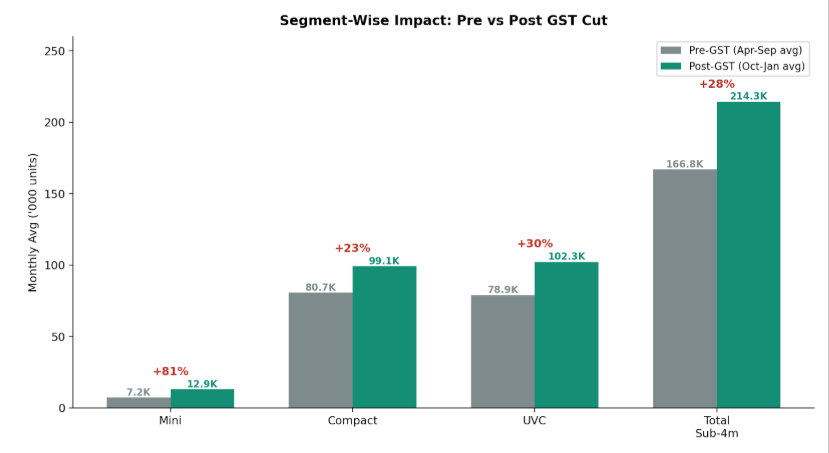
When Mini cars, Compact cars (Swift, Baleno, WagonR, Dzire) and UVC SUVs (Brezza, Venue, Nexon, XUV 3XO) are combined, the pre-GST monthly average was 1.67 lakh units/month.
The post-GST average, on the other hand, is 2.14 lakh units — an increase of 28.5 per cent. Moreover, this is not a figure inflated by a single good month. October was the highest at 2.20 lakh, but November (2.06 lakh), December (2.19 lakh) and January (2.13 lakh) all remain in the 2.05-2.20 lakh band, well above the pre-GST ceiling of 1.75 lakh.
At the same time, there are subtle differences in how the three sub-4m segments responded, each reflecting distinct competitive dynamics and buyer profiles.
Mini (+80.6 per cent): This one showed the strongest response. This segment was most price-constrained and had the most latent demand waiting for a trigger.
UVC (+29.6 per cent): Sub-4m SUVs recovered from the mid-year weakness that had seen them drop to 71,000–79,000 units, climbing back to a sustained 97,000–109,000 range. The GST cut helped, but as the next story explores, the segment’s issues were partly structural.
Compact (+22.8 per cent): The workhorse segment of the Indian market stepped up from an 80,700 average to 99,130. With Maruti’s Swift, Baleno, WagonR, and Dzire forming the core, the Compact segment settled at a consistent floor just below 100,000 — a level it had rarely touched in the pre-GST period.
 Above-4m Segments: The Control
The data offers a natural control group in the form of UV1 and UV2 — SUV segments that sit above 4 metres and were not directly affected by the GST rate change. UV2 (4.4–4.7m: Scorpio, XUV700, and Thar Roxx) moved from an average of 39,569 to 41,422 — a 4.7 per cent increase that is well within normal seasonal variation and cannot be attributed to the tax change.
UV1 (4.0–4.4m) shows a larger increase of 34.9 per cent, but this is driven almost entirely by Maruti’s product expansion — the addition of e Vitara and Victoris to its UV1 portfolio, which nearly doubled Maruti’s UV1 volumes. Strip out the Maruti effect, and the remaining UV1 players show modest movements.
This contrast between GST-affected and non-affected segments strengthens the case that the sub-4m growth is genuinely policy-driven rather than a coincidence of seasonal or macroeconomic factors. The festive season (September–October) would have lifted all segments, but it does not explain why sub-4m vehicles rose 28.5 per cent while UV2 moved just 4.7 per cent.
The Share Shift
Sub-4m vehicles accounted for 55–58 per cent of total PV wholesales in the pre-GST period. This share has remained in a broadly similar range post-GST (55–63 per cent), reaching a peak of 62.7 per cent in December, a month when above-4m volumes were seasonally depressed. The fact that the share has not expanded permanently suggests that the GST cut raised the absolute volume of the sub-4m market without necessarily cannibalising the larger vehicle segments. In other words, the policy appears to have expanded the overall pie rather than merely redistributing it.
Total PV wholesales averaged 2,96,232 units per month before the GST cut and 3,70,784 after — a 25.2 per cent increase. Not all of this is attributable to the tax change (festive season effects and new product launches play a role), but the sub-4m segments clearly account for the bulk of the step-up.

RELATED ARTICLES

Vinfast India sells 14,600 EVs since market entry 14 months ago
 Ajit Dalvi
 16 Oct 2026
Vietnamese EV maker, which entered India in September 2025, delivers noteworthy performance to be ranked fourth in the e...


Hyundai Creta Sales Surpass 1.5 Million Units, Exports Nearing 300,000 Units
Ajit Dalvi
15 Oct 2026
Launched on July 21, 2015, Hyundai’s as well as India’s best-selling midsize SUV offered with petrol, diesel and electri...

Mahindra XUV 3XO crosses 500,000 sales ahead of new CNG model launch
Ajit Dalvi
14 Oct 2026
The XUV 3XO and its donor model, the XUV300, have surpassed half-a-million wholesales seven-and-a-half years after the X...