Follow us
India’s EV Transition Runs on Home Charging: Why It’s Still Overlooked
Residential charging accounts for the majority of EV users' needs, but electrical systems in Indian homes remain unprepared and unregulated for the sustained load.
 15 Aug 2026
 1556 Views
Share -
1556 Views
Share -


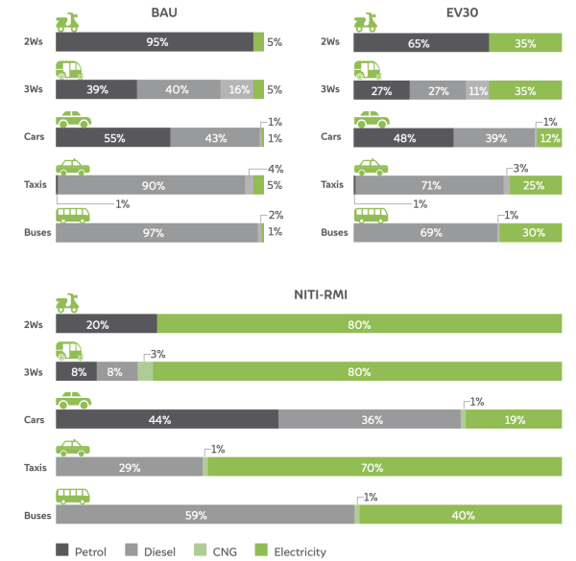
India's EV ambition is accelerating. The EV30@30 campaign, targeting a 30% share for electric vehicles by 2030, signals the country's commitment to greener urban mobility and stronger energy security. But achieving that ambition will depend less on highways and more on homes.
Residential charging powers 60–80% of an EV user’s total charging demand in India, yet remains poorly understood and under-reported. While public infrastructure dominates policy and discourse, the everyday reality of EV adoption is shaped elsewhere in homes, in parking basements and in the electrical systems that support them. If EV30@30 is the destination, residential charging is where that ambition must be realised.
The Backbone, Yet Overlooked
The challenge is not one of consumer willingness, but whether the electrical systems inside Indian homes are ready to support the sustained, high-duration load that EV charging demands, reliably and safely.
The gap begins at the home itself. A typical Indian household operates on a sanctioned load of under 4 kW, often insufficient for EV charging without upgrades. But the problem runs deeper than load capacity alone. Wiring quality, earthing adequacy, voltage stability, and metering accuracy vary widely across India's housing stock, and none of these are currently assessed or upgraded as part of any systematic EV-readiness framework. A two-wheeler can be charged with a 3.3 kW AC charger, and four-wheelers may require up to 7.4 kW but neither is viable if the underlying electrical infrastructure at the home level is unreliable. The invisible part is whether the home's electrical system is safe and stable enough to support charging at all.
This is where the real irony of India's EV story lies. This challenge cuts across housing types. As EV adoption accelerates, charging is becoming a daily, high-duration activity that places sustained demand on residential electrical systems. What appears as a charging issue is often the result of the interaction between home infrastructure and grid conditions, rather than a single point failure.
The absence of standardised home charging frameworks compounds this. There is no common benchmark for what an EV-ready home should look like, no minimum wiring standard, no earthing requirement, no guidance on metering for EV loads. This creates ambiguity for installers, risk for users, and no accountability for anyone. Solving residential charging is central to addressing range anxiety. When charging at home is reliable, predictable, and safe, EV ownership becomes effortless rather than uncertain. This is especially important for users who rely on their vehicles every day—delivery fleets, shared mobility operators, and daily commuters—where a missed charge is not an inconvenience, but a disruption. As EV adoption scales, it is this everyday confidence in charging that will determine how far and how fast the transition can go.
The Cost Reality Driving Adoption
Home charging is not just more accessible, it is significantly more economical, costing roughly ₹8 per kWh compared to ₹25 at public charging stations. For the two- and three-wheelers that dominate India's roads, this difference directly shapes total cost of ownership and determines whether EV adoption is financially viable for mass-market users. For cost-sensitive households, home charging isn't a convenience, it's the condition under which owning an EV makes economic sense
This cost advantage is increasingly being reinforced by policy. Several states have introduced EV-specific electricity tariffs, along with provisions such as separate EV metering and emerging time-of-use pricing, to make residential charging more affordable and predictable. Together, these measures align with how EVs are actually used, at home, on a daily basis, strengthening the role of residential charging as the foundation of mass-market EV adoption.
From Grid Stress to Grid Intelligence
As EV adoption scales, uncoordinated residential charging could place significant stress on local distribution networks. If multiple users in a locality charge simultaneously during evening peak hours, it can create demand spikes that existing infrastructure is not designed to handle.
But this is not just a constraint, it is a system design opportunity.
With smart charging, residential EV charging demand can be aligned with grid capacity. Charging can be shifted to non-peak hours, staggered across users, and integrated with real-time load conditions. This reduces peak demand pressure while improving overall grid utilisation.
For DISCOMs, this represents a fundamental shift from passively supplying electricity to actively managing demand. Residential charging, when digitally integrated, can enable better load balancing, reduce infrastructure stress, and support a more efficient, responsive power system.
In this sense, home charging is not just about enabling EV adoption, it is central to how India’s power system evolves alongside it.
Conclusion: Where the EV Transition Will Be Won
India's EV transition is often pictured as a story of technology and infrastructure: new vehicles, new corridors, new public charging networks. But the deeper transformation is happening in homes, in the reliability of everyday charging, and in the confidence that for users who depend on their vehicles every day, it will be ready to start each morning.
That is where the transition will be won or lost.
Getting there requires the built environment to catch up: new housing designed with EV-ready wiring and earthing from the outset, not retrofitted at far greater cost a decade later. It requires DISCOMs to evolve from passive billing to active demand management, using residential charging as a lever to build a more responsive grid rather than treating it as a stress on an existing one.It also requires ensuring stable and predictable power supply at the last mile. And it requires an ecosystem that can support this transition at scale—anchored in a skilled workforce capable of assessing, installing, and maintaining systems to ensure reliable and consistent charging outcomes.
None of this is peripheral. It is the foundation on which every other part of India's EV ambition rests. The vehicles are ready. The demand is there. What remains is ensuring that the homes of India's most committed EV adopters are finally ready too.
Akshay Shekhar is the Co-Founder & CEO of Kazam. Views expressed are the author's personal.

RELATED ARTICLES

India's Electric Two-Wheelers Are Ready. Is the Ecosystem?
 Autocar Professional Bureau
26 Sep 2026
Autocar Professional Bureau
26 Sep 2026
“India’s electric two‑wheeler boom now hinges on charging, service and financing ecosystems.


Can AI Solve India's Automotive Shop-Floor Workforce Challenges?
Autocar Professional Bureau
13 Sep 2026
AI is hiring smarter, managing shifts better, and building skills for the factory of the future.

Can India’s Battery Recycling Ecosystem Keep Pace with Its EV Growth?
Autocar Professional Bureau
13 Sep 2026
India’s EV boom is racing ahead, but its battery recycling ecosystem must scale faster to turn waste into a secure resou...