Follow us
Two-Wheeler Retail Sales Cross 18.44 Lakh Units In May As EV Adoption Gains Momentum
Two-wheeler retail sales grew 7.54 percent year-on-year to 18.44 lakh units in May, supported by urban demand and improving alternative powertrain adoption despite seasonal weakness.
 08 Jun 2026
 3551 Views
Share -
3551 Views
Share -


Two-wheeler retail sales rose 7.54 percent year-on-year to 18.44 lakh units in May 2026, up from 17.15 lakh units in the corresponding period last year, although volumes declined 7.19 per cent sequentially from April’s 19.87 lakh units amid seasonal moderation and heatwave-related disruptions.
The segment remained the largest contributor to overall retail volumes, accounting for nearly 73 per cent of the total 25.31 lakh vehicles retailed during the month. FADA noted that growth was supported by commuter demand, marriage-season purchases and continued rural participation, though heat conditions and supply constraints affected showroom activity in some regions.
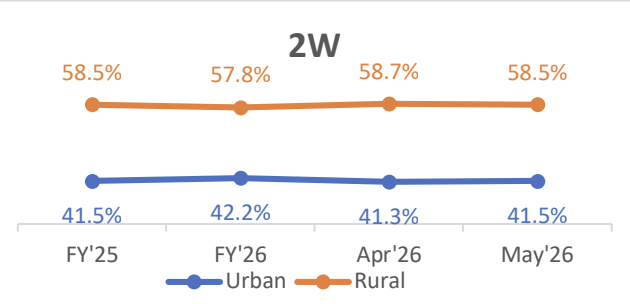 Urban demand outperformed rural markets during the month. Urban two-wheeler retail sales increased 11.75 percent year-on-year, while rural markets grew 4.74 per cent. Despite slower growth, rural markets continued to account for a larger portion of sales, representing 58.5 per cent of total registrations compared with 41.5 per cent for urban centres, according to FADA’s retail strength index.
Fuel-price movements also influenced powertrain preferences. Electric two-wheelers accounted for 9.25 per cent of total segment retail sales in May, up from 6.11 per cent a year earlier and 7.92 per cent in April. Petrol-powered models continued to dominate with a 90.68 per cent share, although this declined from 93.67 per cent last year, indicating gradual diversification toward alternative options. CNG-powered two-wheelers remained negligible at 0.07 per cent share.
At the OEM level, Hero MotoCorp retained leadership with retail volumes of 5.18 lakh units and a 28.07 per cent market share, although this was lower than last year’s 29.57 per cent. Honda Motorcycle & Scooter India strengthened its position with 4.52 lakh units and a 24.52 per cent share, while TVS Motor Company retailed 3.56 lakh units for a 19.32 per cent share. Among EV-focused players, Ather Energy more than doubled volumes to 28,240 units, while Ola Electric’s retail volumes declined to 15,141 units from 18,967 units last year.
Looking ahead, dealer expectations remain linked to rural cashflows, monsoon progress and continued migration toward fuel-efficient models, though fuel prices and weather remain watch factors.

RELATED ARTICLES

Volvo Cars names Skoda’s Klaus Zellmer as new president, CEO
 Autocar Professional Bureau
20 Sep 2026
Autocar Professional Bureau
20 Sep 2026
Zellmer will take the new role in October 2027.


Volvo’s 20:1 Compression Ratio Breakthrough: How Dual-Wave Pistons Could Deliver 4% Fuel Savings for Indian Fleets
 Shahkar Abidi
20 Sep 2026
Shahkar Abidi
20 Sep 2026
A decade after its engineers reshaped the piston crown and halved diesel soot, Volvo has doubled down, on the design at ...

Weekly News Wrap: Record Auto Sales Spur Production Push, Fresh Investments
 Darshan Nakhwa
20 Sep 2026
Darshan Nakhwa
20 Sep 2026
The week saw Kia and Hyundai raise production on strong demand, passenger vehicle and scooter volumes hSemiit fresh hig...