Follow us
Toyota Kirloskar Motor Presents Sustainable Vehicle Portfolio at India Energy Week 2025
Japanese auto giant showcases hybrid, electric, and hydrogen vehicles while highlighting its progress in renewable energy adoption and local manufacturing capabilities in line with India's sustainability goals.
 By Sarthak Mahajan
 14721 Views


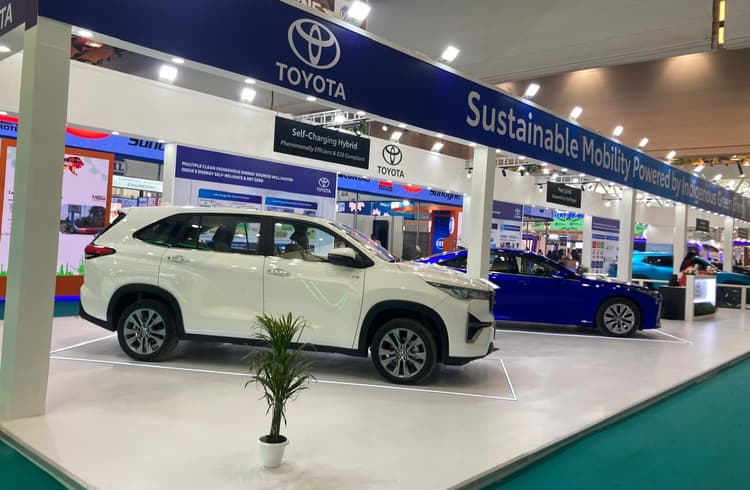
Toyota Kirloskar Motor (TKM) unveiled its sustainable mobility portfolio at India Energy Week 2025, demonstrating the company's alignment with India's energy independence and net-zero goals. The four-day event, which opened today in Delhi, brings together industry leaders and policymakers to discuss clean energy solutions.
At the forefront of TKM's exhibition is a range of alternative powertrains designed to reduce dependency on fossil fuels. The showcase includes the Innova Hycross, featuring a hybrid electric system compatible with E20 fuel, and a prototype of the Prius capable of running on 100% ethanol while incorporating plug-in hybrid technology.
The company also presented an urban battery electric vehicle concept and the hydrogen-powered Mirai, alongside locally manufactured e-Drive systems - a crucial component for electrified vehicles.
"India Energy Week creates a vital platform for advancing clean energy and sustainable mobility," said Vikram Gulati, Country Head & Executive Vice President at TKM. He emphasized that Toyota's approach involves multiple pathways to decarbonixation, reflecting the diverse needs of the Indian market.
The automotive manufacturer has made significant strides in its environmental initiatives. TKM's manufacturing operations now run on 100% renewable grid electricity, achieving a cumulative reduction of 447,253 tons in CO2 emissions since 2013. The company has also transformed its logistics operations, with 65% of its northern route transportation shifting to railways, resulting in a 7.7 kg reduction in CO2 emissions per vehicle in the current fiscal year.
In line with India's self-reliance push, Toyota Kirloskar Auto Parts has become the first facility outside Japan in Asia to produce e-Drive systems for both domestic and international markets. The company has extended its environmental commitment to its supply chain, training 139 supplier companies in carbon neutrality practices.
The manufacturer has also invested in workforce development, partnering with over 100 institutions to provide automotive expertise training to more than 180,000 youth across India.
TKM's focus on ethanol-based solutions aligns with recent government initiatives promoting biofuel production from agricultural residues. This approach aims to address multiple challenges, including air pollution from crop burning, while potentially boosting rural economies through increased farmer incomes.
As India continues its push toward clean energy adoption, TKM emphasizes the importance of supportive government policies in creating a viable ecosystem for sustainable mobility solutions. The company suggests that such measures could simultaneously advance environmental goals while strengthening local manufacturing capabilities and employment opportunities.

RELATED ARTICLES

Hyundai BAYON Launched At ₹9.99 Lakh With AI Assistant, Level 2 ADAS
 Eshisha Java
 26 Oct 2026
Hyundai Motor India has launched the BAYON mid-size SUV at ₹9.99 lakh, with a 1.5-litre petrol engine, manual and iVT op...


Hyundai Targets 2.5 Lakh Creta, Bayon Sales to Defend Monocoque SUV Leadership
 Autocar Professional Bureau
26 Oct 2026
Autocar Professional Bureau
26 Oct 2026
The Bayon gives Hyundai a second offering against Maruti Suzuki, Kia, Toyota and Tata in the expanding monocoque mid-siz...

AIDA Eyes E30, Flex-Fuel Vehicles to Drive Next Phase of Ethanol Growth
 Mukul Yudhveer Singh
26 Oct 2026
Mukul Yudhveer Singh
26 Oct 2026
With E20 blending achieved, the distillers' association is advocating higher ethanol consumption through flex-fuel vehic...