Follow us
Tata Motors Deepens AI Adoption Across Product Development, Manufacturing and Service
Company plans to use AI across engineering, manufacturing and after-sales while enabling continuous vehicle upgrades through over-the-air software updates.
 25 Jun 2026
 1104 Views
Share -
1104 Views
Share -


Tata Motors is embedding artificial intelligence (AI) across product development, manufacturing, quality management and after-sales operations as it prepares for the next generation of software-defined vehicles (SDVs), with the technology expected to play a central role in improving quality, reducing development cycles and enhancing customer experience.
The company has identified AI adoption as one of the four key pillars of its technology roadmap over the next five years, alongside battery electric vehicles (BEVs), efficient internal combustion engine (ICE) powertrains, and software-defined vehicles with advanced driver assistance systems (ADAS).
The strategy reflects Tata Motors' shift towards using AI not merely as a digital tool but as an integral part of vehicle engineering, manufacturing and lifecycle management.
"Our ambition is clear to deliver world-class quality, durability, and reliability across our entire portfolio," Tata Motors PV’s Chief Product Officer & Chief Corporate Quality Officer, Mohan Savarkar, said during the Investor Day. "To enable this, we are focusing on four key shifts, predictive quality, built-in quality, leveraging AI, and total quality management."
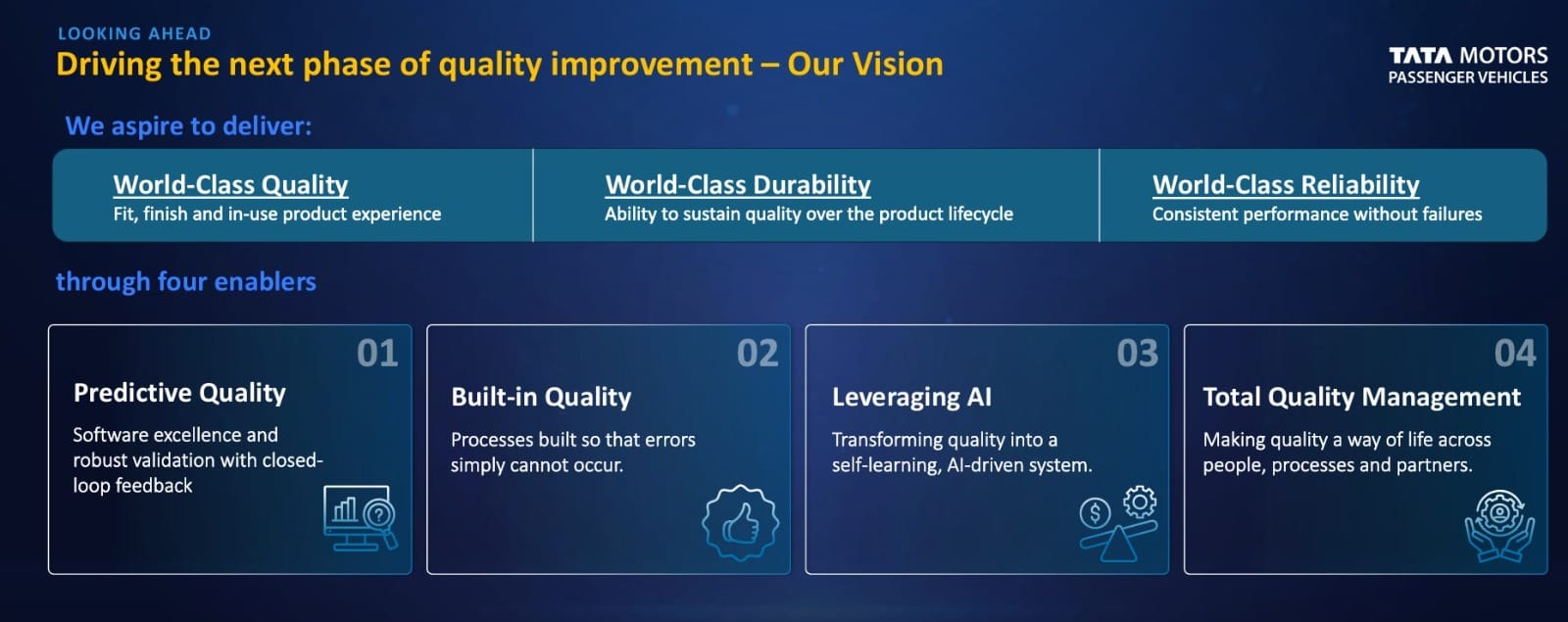
A key pillar of the strategy is predictive quality. Instead of identifying defects after production, Tata Motors aims to detect issues much earlier in the development and manufacturing process.
"We are building the capability to detect early signals, predict outcomes, and prevent issues before they manifest," Savarkar said, adding that digital engineering, diagnostics and software-defined vehicles would enable continuous improvement throughout a vehicle's lifecycle.
The company said software-defined vehicles would allow customers to receive new features and software enhancements through over-the-air (OTA) updates, enabling vehicles to remain technologically current without requiring hardware changes.
"Today, if you purchase a car... the car should be able to upgrade itself during your ownership period through over-the-air updates. That's the world of software-defined vehicles," the company’s Managing Director and CEO Shailesh Chandra said.
Within manufacturing, Tata Motors plans to use AI to create what it describes as a "self-learning quality system". The roadmap envisages AI-powered vision sensing for real-time process monitoring, predictive analytics to identify failures before they occur, automated corrective actions and continuous learning to improve manufacturing precision.
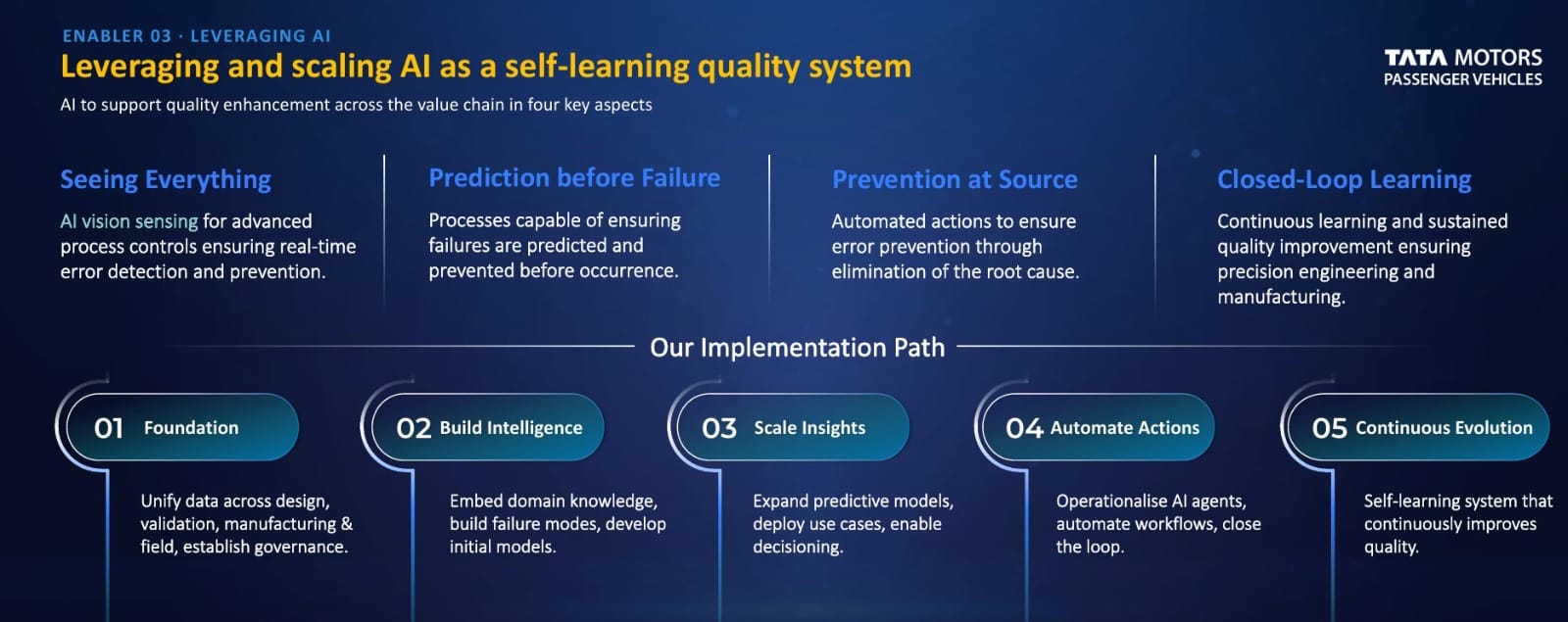
The implementation framework spans five stages, from building a unified data foundation and developing predictive models to operationalising AI capabilities and creating a continuously evolving quality system.
Beyond the vehicle itself, AI is expected to support quality enhancement through vision sensing, prediction before failure, prevention at source and closed-loop learning, allowing manufacturing and engineering processes to improve continuously.
The company is also extending AI into its after-sales operations. During the Investor Day, it highlighted the use of AI-led diagnostic tools to improve fault detection and repair effectiveness while strengthening digital engineering capabilities to support increasingly software-defined vehicles.
The technology push comes as automakers globally race to build software-centric vehicles capable of receiving continuous software upgrades, adding features remotely and improving vehicle performance throughout ownership, reducing dependence on traditional hardware refresh cycles.

RELATED ARTICLES

SWITCH Mobility Secures 840 Electric Bus Order Under PM E-Drive
 Eshisha Java
28 Sep 2026
Eshisha Java
28 Sep 2026
SWITCH Mobility has secured an order for 840 electric buses under PM E-Drive, comprising 420 each of 9-metre and 12-metr...


Renault Triber 100PS Launched At Rs 7.84 Lakh, Debuts RGEP
Eshisha Java
28 Sep 2026
Renault Triber 100PS launches from Rs 7.84 lakh with the new RGEP platform, 100hp turbo engine, 180Nm torque and 21kpl c...

Amara Raja Opens Nominations For 4th Better Way Awards, Adds Student Category
Eshisha Java
28 Sep 2026
Amara Raja has opened nominations for its fourth Better Way Awards, with a new category for students developing solution...