Follow us
Quick-Commerce Boom Creates New Demand Segment for India’s Electric Two-Wheeler Makers: BCG
Delivery riders travelling 400–500 km a week are emerging as a distinct customer group, with affordability, speed and manoeuvrability shaping vehicle preferences, according to a BCG report.
 By Darshan Nakhwa
 1 Views


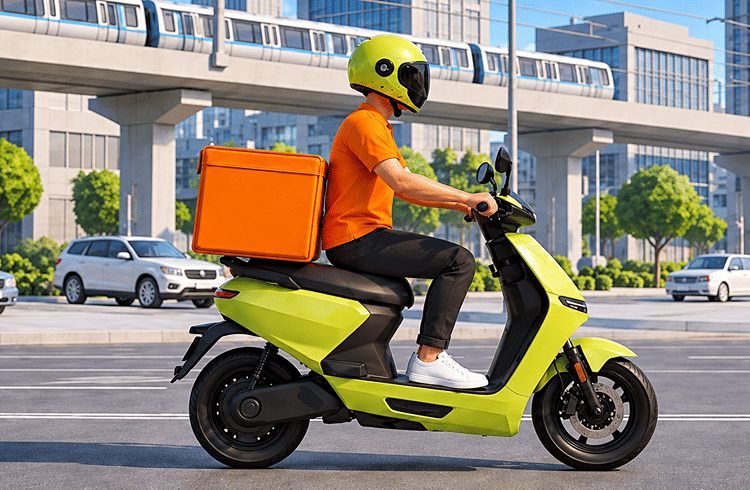
India’s rapid growth in quick commerce and food delivery is creating a new category of two-wheeler buyers, opening opportunities for electric vehicle manufacturers to develop products suited to high-frequency delivery operations, according to a Boston Consulting Group (BCG) report.
The report, titled Electric in Charge: How India’s Electric Two-Wheelers Are Moving into the Mainstream, identifies a new consumer segment called “Trip Maximizers”, comprising full-time delivery riders working with quick-commerce and food-delivery platforms. These riders typically cover 400–500 km a week and prioritise affordability, speed and ease of manoeuvrability when choosing a two-wheeler.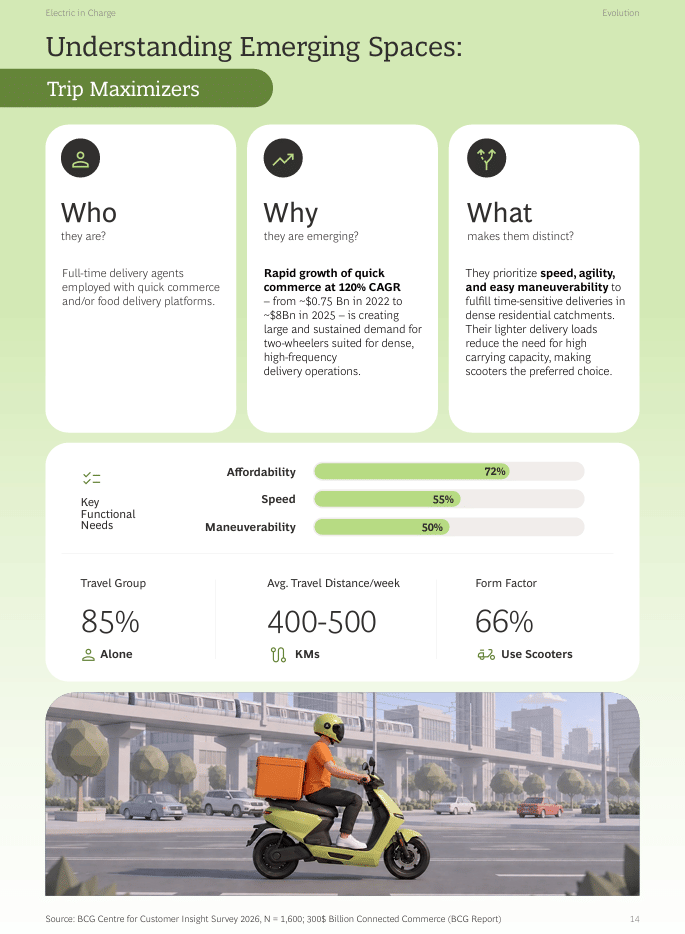 The emergence of this segment comes amid the rapid expansion of India’s quick-commerce industry, which grew from approximately $750 million in 2022 to $8 billion in 2025, representing a compound annual growth rate of around 120%, according to the BCG report.
According to the survey, affordability is the most important consideration for 72% of riders in this segment, followed by speed at 55% and manoeuvrability at 50%. Around 66% use scooters, while 85% typically travel alone.
BCG noted that these riders generally carry lighter delivery loads and place greater emphasis on speed and agility than on carrying capacity. This makes scooters a preferred choice for high-frequency delivery operations.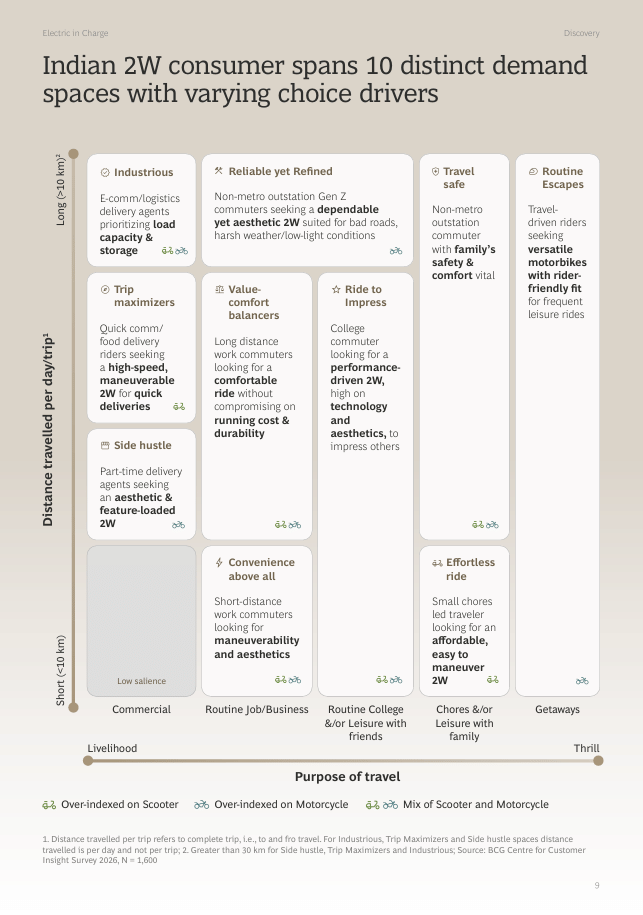 The report distinguishes these riders from another commercial two-wheeler segment, called “Industrious”, comprising delivery and logistics workers who place greater importance on load capacity and storage. Riders in this segment typically travel more than 500 km a week, with affordability, carrying capacity and storage among their key requirements.
The changing requirements of commercial riders come at a time when electric scooters are gaining wider acceptance in India. Electric scooter penetration increased from 16.8% in FY24 to 24.1% in FY27 year-to-date through August 2026, while electric two-wheeler penetration in the overall market rose from 5.5% to 9.9% during the same period, according to BCG analysis.
Beyond commercial use, BCG identified changing preferences among younger buyers in smaller towns, frequent commuters and recreational riders as other factors reshaping two-wheeler demand. Among non-metro Gen Z commuters, suitability for bad roads (59%) and aesthetics (58%) emerged as important considerations, while frequent work commuters increasingly prioritise comfort (71%), mileage (59%) and ease of service (43%). Growing interest in leisure riding is also driving demand for sturdier and more versatile motorcycles.
The report suggests that manufacturers need to develop products around specific usage requirements rather than relying only on price and vehicle type to differentiate their offerings.
For high-utilisation delivery riders, this would mean greater emphasis on battery longevity, range and products suited to intensive daily usage. BCG identifies designing for specific operating requirements as one of the priorities for manufacturers, citing delivery riders travelling more than 60 km daily as an example.
The report also highlighted the need for manufacturers to strengthen the ownership experience through convenient servicing, battery and warranty assurance, insurance, and resale or exchange support.
BCG said the next phase of electric two-wheeler growth will favour manufacturers that identify distinct customer requirements and tailor their products, portfolios and sales strategies accordingly.
While the report identifies delivery riders as an emerging two-wheeler customer group, it does not quantify electric vehicle penetration within this segment. The opportunity for electric two-wheeler manufacturers will therefore depend on how effectively they address the operating costs, product requirements and reliability expectations of commercial users.

RELATED ARTICLES

Volkswagen Group Partners With NXP For Future SDV Architecture
 Eshisha Java
 26 Oct 2026
Volkswagen Group partners with NXP to integrate S32K5 microcontrollers into its future zonal vehicle architecture, with ...


EMO Energy Deploys 25,000 Battery Packs, Q2 Energy Delivery Rises 35%
Eshisha Java
26 Oct 2026
EMO Energy deployed around 6,000 battery packs in Q2 FY27, taking cumulative deployments to 25,000, while quarterly ener...

Ather Energy To Invest ₹122 Crore In Manufacturing Capacity Expansion
Eshisha Java
26 Oct 2026
Ather Energy plans to raise annual electric two-wheeler production capacity at its Hosur and Chhatrapati Sambhajinagar f...