
 Follow us
Maruti Suzuki Reaches 3 Million Rail Dispatches Milestone
The automaker has increased its share of rail-based vehicle dispatches from 5% to 26.5% over the past decade, backed by over ₹13,720 million in logistics infrastructure investment.
 782 Views


Maruti Suzuki India Limited announced on Wednesday that it has cumulatively dispatched over 3 million vehicles through railways, a threshold the company crossed in March 2026. The milestone marks a notable point in the automaker's decade-long effort to shift its outbound logistics away from road transport and toward rail, a move the company frames as central to reducing its carbon footprint and easing road congestion.
The progression from 2 million to 3 million cumulative rail dispatches took 21 months, shorter than the 2 years and 7 months it took to move from 1 million to 2 million, and significantly shorter than the 7 years and 8 months it took to reach the first million after rail operations began in 2014. The company said this acceleration reflects the expansion of its rail infrastructure and increased operational capacity in recent years.
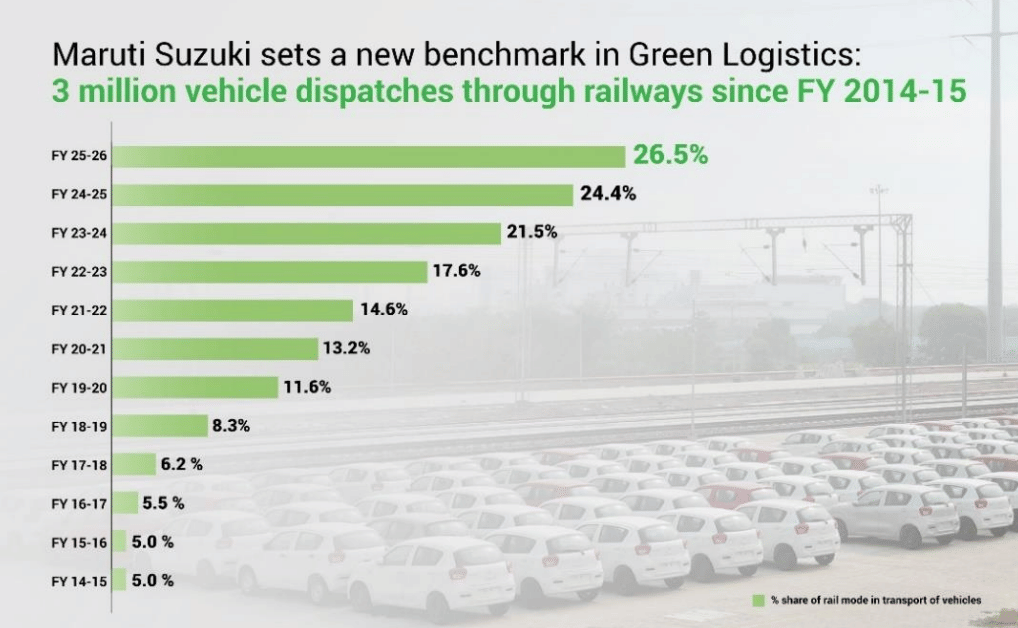
The share of rail in the company's total outbound vehicle dispatches has grown from 5% in FY 2014-15 to 26.5% in FY 2025-26, representing a more than fivefold increase over the period. According to the company, rail-based dispatch volumes have grown ninefold since 2014 in absolute terms. Maruti Suzuki said it has committed over ₹13,720 million toward rail logistics infrastructure, covering in-plant railway sidings at its Hansalpur and Manesar manufacturing facilities, rail yards at logistics hubs, procurement of specialized automotive rakes, and supporting infrastructure upgrades.
 Maruti Suzuki is currently the only passenger vehicle manufacturer in India with operational railway sidings at two of its plants. The Hansalpur siding in Gujarat, which began operations in March 2023, was formally inaugurated by Prime Minister Narendra Modi virtually in March 2024. In February 2026, the siding was registered as the world's first Modal Shift Transportation Project under the Verified Carbon Standard program of Verra, an international carbon credit registry and certification body. This recognition ties the facility's operations to quantifiable carbon reduction metrics under a globally accepted standard.
The Manesar siding in Haryana, described as India's largest automobile in-plant railway siding, was inaugurated in June 2025 by Union Minister for Railways Ashwini Vaishnaw and Haryana Chief Minister Nayab Singh Saini. The facility crossed 1 lakh vehicle dispatches by March 2026. Together, the two sidings have a combined annual dispatch capacity of 750,000 vehicles.
The rail network services more than 600 cities across the country through 22 hubs, operating on a dedicated hub-and-spoke model. Vehicles manufactured at the company's Gurugram, Manesar, and Gujarat plants — including the Swift, Baleno, WagonR, Brezza, Grand Vitara, Fronx, Dzire, Ertiga, Alto, Celerio, XL6, Eeco, and Super Carry — are transported through this network. The rail infrastructure also connects to the export ports of Mundra and Pipavav, extending its utility beyond domestic distribution.
In October 2025, the company transported its first batch of vehicles by rail to the Anantnag terminal in the Kashmir valley, marking an extension of rail-based delivery to a region that had not previously been part of the network. The development was notable given the geographical and logistical challenges associated with freight movement to that area.
Managing Director and CEO Hisashi Takeuchi said the company aims to raise the share of rail-based dispatches to 35% by FY 2030-31 and plans to add an in-plant siding at its upcoming Kharkhoda facility in Haryana, which is currently under development. He credited the government's PM GatiShakti National Master Plan — a multimodal connectivity initiative launched in 2021 — as providing the enabling framework for the company's rail logistics expansion.
Maruti Suzuki first entered rail logistics in May 2013, when it became India's first automobile manufacturer to obtain an Automobile Freight Train Operator (AFTO) license, which allows private operators to run freight trains on Indian Railways' network. The first Flexi-deck auto wagon rake — a specialized rail wagon designed to carry multiple vehicles on two levels — was flagged off in March 2014. By July 2022, the company and its AFTO partners had inducted 40 such rakes. The company reached 1 million cumulative rail dispatches in November 2021 and 2 million in June 2024.
The broader context for this shift is India's push to increase the share of freight moved by rail, which is generally more fuel-efficient and less carbon-intensive per tonne-kilometre than road transport. The automobile sector has historically relied heavily on car carriers operating on highways, and Maruti Suzuki's scale — it accounts for roughly two-fifths of India's passenger vehicle sales — makes its logistics choices consequential for overall freight patterns in the sector.

RELATED ARTICLES

Mahindra Sees ‘Latent Demand’ for Lifestyle Pickups, Starts Six-Month Market Study
 Darshan Nakhwa
 15 Aug 2026
The automaker will use the run-up to the April 2027 launch of the Scorpio Lifestyler to understand potential buyers and ...


Mahindra In No Rush To Enter UK, Sees Indonesia as Easier Expansion Bet: Gollagunta
 Autocar Professional Bureau
15 Aug 2026
Autocar Professional Bureau
15 Aug 2026
The automaker says it will enter the UK only when it is confident it can build a sustainable business, while its growing...

Google Cloud and Mahindra Integrate AI Assistant into New Electric SUV
 Angitha Suresh
15 Aug 2026
Angitha Suresh
15 Aug 2026
Mahindra has become the first Indian automaker to deploy a conversational AI agent built on Google's Gemini Enterprise p...