Follow us
MAHLE Bets on Range Extenders to Bridge Gap Between Diesel and Electric Trucks
The German Tier-1 supplier unveils production-ready system for battery-electric trucks, arguing the technology can ease fleet transition amid charging infrastructure gaps.
 By Darshan Nakhwa
 1762 Views


German automotive supplier MAHLE has unveiled a production-ready range extender system for heavy battery-electric trucks, betting that the technology can accelerate the shift away from diesel by addressing two of the biggest hurdles to fleet electrification, limited charging infrastructure and range anxiety.
The system, which will make its world premiere at the IAA Transportation 2026 exhibition in Hanover in September, combines a battery-electric powertrain with a compact internal combustion engine that acts solely as a generator. Unlike a hybrid vehicle, the engine does not drive the wheels but produces electricity when the battery charge falls, extending the truck’s driving range.
“Our range extender is a smart ‘emergency power unit’ that is activated at precisely the right moment and significantly increases the range available,” said Dr Marco Warth, Vice President, Corporate Research and Advanced Engineering, MAHLE.
The company said the system enables a battery-electric truck to travel more than 800 km, with around 400 km powered by the battery and the remainder provided by the range extender. By replacing roughly one-third of the battery pack with the compact power unit, MAHLE said the vehicle’s weight can be reduced by about 600 kg, helping improve payload capacity and lower total cost of ownership.
The new system consists of a 110-kW high-voltage generator, capable of delivering up to 130 kW peak output, coupled with a compact combustion engine. MAHLE has packaged the generator, engine, thermal management system, fuel tank and exhaust after-treatment into a single module that can be integrated into existing battery-electric truck platforms.
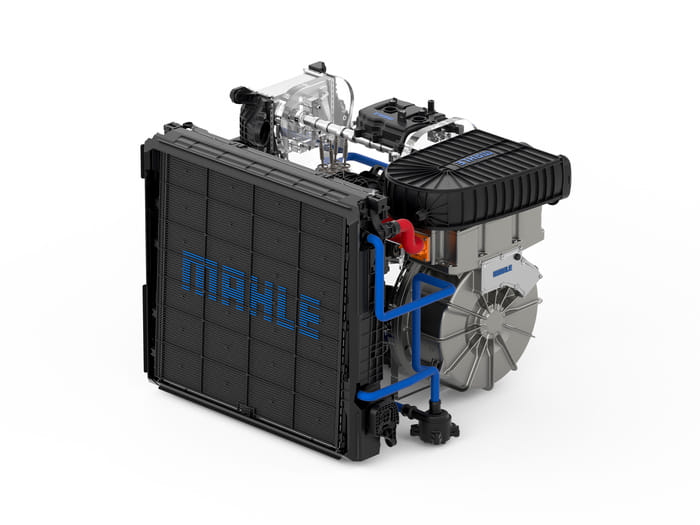
The MAHLE Group’s new range extender system for heavy electric trucks.
The supplier said the architecture is aimed at fleet operators seeking to electrify operations without relying entirely on a still-developing public charging network.
“Time and energy are limited, valuable resources, especially in the road transport business; only operators who work economically can survive. With electrification products, MAHLE can help make heavy trucks more efficient and flexible at the same time as reducing operating expenses,” said Arnd Franz, Chairman of the Group Management Board and CEO of MAHLE.
The company estimates that, under real-world operating conditions, a truck operating in range extender mode emits around 80% less CO₂ than a conventional diesel truck. It added that the engine is compatible with renewable fuels such as HVO100, allowing emissions to be reduced further.
The announcement comes as commercial vehicle manufacturers continue to face slower-than-expected adoption of battery-electric trucks. Industry executives have repeatedly pointed to inadequate charging infrastructure, high battery costs and concerns over vehicle utilisation as key barriers to large-scale deployment. The commercial vehicle industry has increasingly been exploring multiple powertrain pathways, including battery-electric, hydrogen fuel cells, renewable fuels and range extenders.
MAHLE believes range extenders can serve as a transition technology until charging infrastructure becomes more widespread.
“Our range extender is the key to disconnecting the market ramp-up of battery-electric trucks from the inadequate pace of infrastructure development. If the charging station is busy, or alternative routes are called for because of weather conditions or congestion, an e-truck with a range extender just carries on,” Warth said.
Beyond the range extender, MAHLE also unveiled a rare-earth-free electric motor for heavy commercial vehicles. The company said the motor is around 10% lighter than conventional permanent-magnet motors and eliminates the use of rare earth materials, helping reduce supply chain dependence and environmental impact.
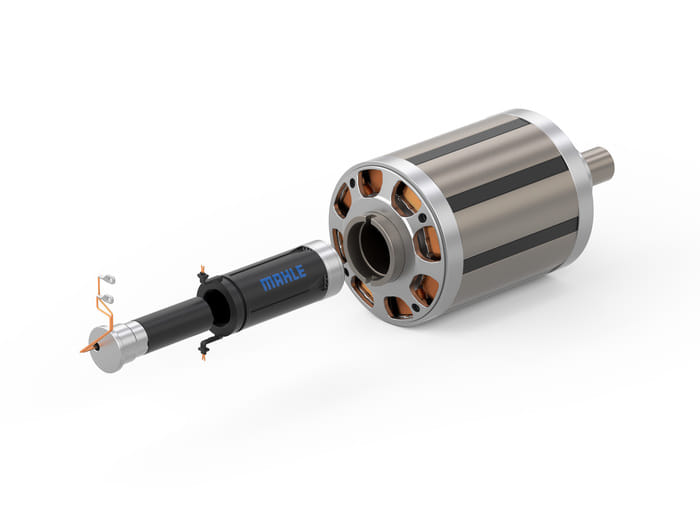
The new MCT electric motor from MAHLE for use on the electric drive axles of heavy trucks is not equipped with permanent magnets and therefore does not require any rare earth elements.
Commercial vehicles account for around 20% of MAHLE’s automotive business, and the supplier expects to outpace market growth over the next five years as truck electrification gathers pace.
“With high-performance technologies and production-ready products for electrification we are aiming for further growth,” Franz said.
Despite its push into electrification, MAHLE maintained that no single technology will deliver road transport decarbonisation. The company said battery-electric trucks, hydrogen and renewable fuels would all have a role to play, while calling for faster expansion of charging and hydrogen infrastructure alongside supportive regulation.

RELATED ARTICLES

India to Anchor Daimler Truck’s New 42-Country ISEAA Region
 Mukul Yudhveer Singh
 14 Sep 2026
Torsten Schmidt takes charge of the new ISEAA region spanning India, South-East Asia and Australia-Pacific as Daimler Tr...


Bounce Joins ONDC Open Delivery Protocol to Expand EV-Led Last-Mile Logistics
 Arunima Pal
14 Sep 2026
Arunima Pal
14 Sep 2026
The partnership brings Bounce’s electric mobility, fleet operations and gig-worker platform into ONDC’s logistics ecosys...

Exclusive: Zero-Emission Truck Infra Must Ultimately Be Private: Daimler CEO
Mukul Yudhveer Singh
14 Sep 2026
After calling out Europe, Daimler CEO Karin Rådström tells Autocar Professional exclusively that the infrastructure chal...