

 Follow us
India’s Electric Bus Market Soars 81%, Poised for 15% Share by 2027
India's electric bus sector is gaining momentum amid the country's transition to greener public transportation, with potential for significant expansion as manufacturing capacity and government support increase.
 By Angitha Suresh
 13850 Views


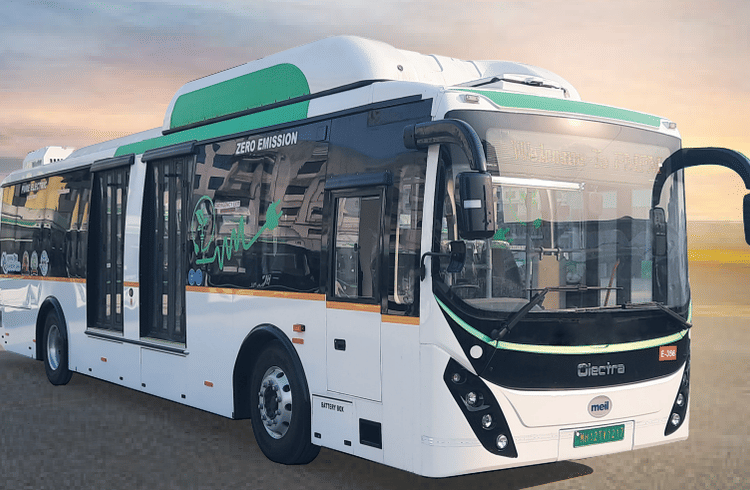
India's electric bus market recorded impressive growth with sales surging 81% year-on-year in fiscal year 2024, though they still represent only 4% of the country's annual bus registrations. According to data from the Vahan Dashboard, 3,644 electric buses were sold in FY24, gradually eating into the market share of conventional diesel and petrol buses, which has declined from 97-98% a decade ago to 90% in FY24.
The country's electric bus potential remains largely untapped, with just six e-buses per million people compared to the global average of 85. Currently, adoption is concentrated in a few states, with Maharashtra leading at 2,423 registrations, followed by Delhi with 2,361 and Karnataka with 1,473.
Five manufacturers dominate the market, with Tata Motors, Olectra, JBM, PMI, and Switch Mobility controlling 88% of market share in FY24. These companies have a combined manufacturing capacity of 40,500 electric buses annually and hold an order book of approximately 20,000 buses to be delivered within the next two years.
Cost efficiency is proving to be a major driver for adoption. The total cost of ownership (TCO) for air-conditioned electric buses is approximately 15-20% lower than diesel buses over a 12-year period, despite higher initial purchase prices. This cost advantage stems from lower fuel and maintenance expenses, making them increasingly attractive for public transport operators.
The Gross Cost Contract (GCC) model has been instrumental in accelerating adoption among State Transport Undertakings (STUs). This asset-light approach has largely replaced the traditional outright purchase model, especially in larger cities, as it relieves STUs from operation and maintenance responsibilities. However, the weak financial profile of many STUs remains a concern for operators, though payment security mechanisms are being implemented to address this issue.
India's bus industry was among the last sectors to recover from the COVID-19 pandemic, with sales volumes declining sharply in FY21 before gradually rebounding. The industry is expected to exceed pre-pandemic volumes by the end of FY25.
Government initiatives like the Faster Adoption and Manufacturing of Hybrid and Electric Vehicles (FAME) schemes and PM e-Bus Sewa have provided crucial support for the sector's development. With continued policy push and improving infrastructure, annual sales of electric buses are projected to reach over 17,000 units in FY27, representing approximately 15% of total bus sales in the country.
Experts note that adoption has primarily been limited to STUs and intra-city transportation. Future growth depends on private bus operators embracing electric vehicles, which would require improved charging infrastructure with fast-charging facilities for inter-city transportation. Additionally, the evolution of innovative business models will be necessary to sustain the sector's growth, as the asset-heavy nature of the GCC model may limit manufacturers' ability to bid for multiple tenders.
India's ultimate goal is to replace 800,000 diesel buses by 2030, including 550,000 private buses. The private sector, which constitutes 90% of India's bus fleet, has seen minimal electrification due to insufficient incentives, presenting both a challenge and opportunity for future growth in the electric bus market.

RELATED ARTICLES

Suzuki to Launch New e SKY EV in Japan on November 16
 Dev Vadchhedia
 07 Oct 2026
Suzuki introduces its first electric kei car built on HEARTECT-e platform with a 310-kilometre WLTC range.


JSW MG Launches Limited-Edition Hector Storm Series at Rs 19.99 Lakh
 Autocar Professional Bureau
07 Oct 2026
Autocar Professional Bureau
07 Oct 2026
JSW MG introduces Hector Blackstorm and Snowstorm editions with dark-themed styling accents.

Trev Mobility to Raise $2 Million for Premium EV Fleet Expansion
Dev Vadchhedia
07 Oct 2026
Trev targets 300 vehicles by FY27 and plans multi-city expansion across Bengaluru and Mumbai.