Follow us
Google-Kantar Study: 93% Of Car Buyers Use AI In Research
A Google-Kantar study of 1,022 recent car buyers in India finds AI, YouTube and Google Search are increasingly shaping vehicle research and brand consideration.
 45 Views


Google and Kantar’s Automobile Purchase Journey in the Age of AI study finds that 93% of surveyed car buyers used AI surfaces during their active vehicle research, highlighting the growing role of conversational and generative AI in the purchase journey. The study surveyed 1,022 car buyers in metros and Tier 1 cities who had purchased a car within the previous six months, with fieldwork conducted in May 2026.
The study also finds that car buying is a non-linear process spanning casual exploration, active research, validation and the final purchase decision. While three in four buyers said they casually explore automotive content before entering the market, 63% said they decided on their final brand during active research.
AI Becomes Part Of The Active Car Research Journey
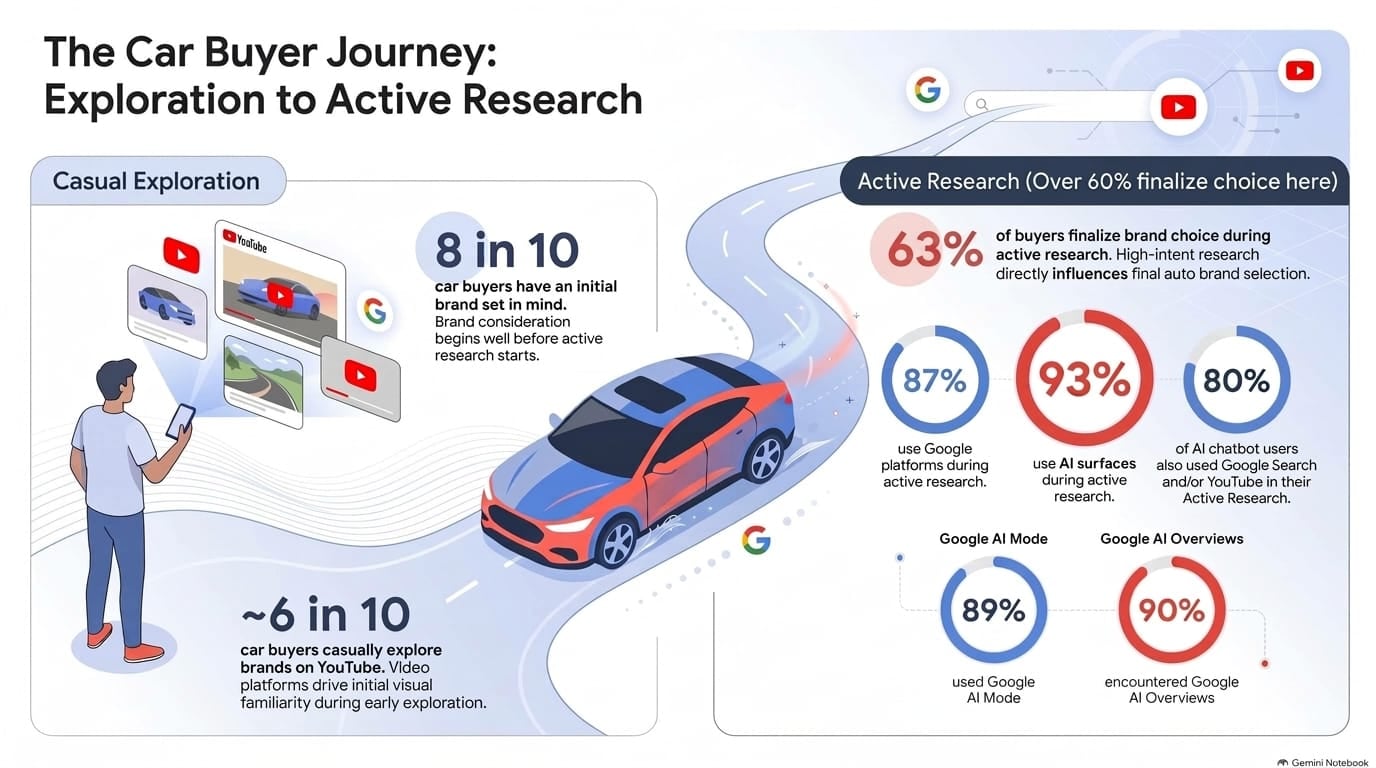 According to the study, 87% of auto buyers used one or more Google platforms during active research, with Google Search rated as the most helpful and most-used channel among the platforms tracked. The journey covered Google Search and Gemini for research and synthesis, YouTube and YouTube Shorts for visual content and reviews, and Google Maps for dealership visits and test drives.
Among those using Google Search, 90% said they encountered AI Overviews and 89% said they used Google AI Mode during their research. The study defines AI surfaces as conversational AI assistants such as Gemini alongside generative AI experiences in Google Search, including AI Overviews and AI Mode.
The report also points to a change in the nature of automotive searches. Google Trends data cited in the study shows a 20% increase in car-related search queries in 2026 compared with 2025, while searches are becoming more specific and conversational. Examples include queries combining vehicle type, price, location, driving conditions and mileage requirements.
AI Expands The Number Of Research Touchpoints
The study found that AI users engaged with more sources during the vehicle purchase process. Buyers who used AI averaged 7.8 touchpoints, compared with 6.9 among buyers overall, representing a 13% difference.
The report identifies five key activities for which consumers use AI surfaces: exploring available options, prioritising features and requirements, comparing technical specifications, creating a shortlist and finalising purchase considerations such as negotiation strategies or financing and EMIs.
AI-assisted research also does not replace conventional search and video platforms. 80% of surveyed buyers who used AI chatbots also used Google Search and/or YouTube during active research, indicating that consumers move between AI-assisted discovery, search and video research.
YouTube Shapes Early Car Consideration
YouTube remains a major source of automotive discovery before buyers begin active research. Around six in 10 car buyers said YouTube helped shape their initial consideration set, ahead of TV at 40%, word of mouth at 38%, social media at 34%, automotive portals at 34% and manufacturer websites at 34%.
Among car buyers who used YouTube, 77% said they used the platform to learn the opinions of respected professional auto experts. The study identifies first looks and walkarounds, comprehensive road tests, head-to-head comparisons, and buyer’s guides and variant analysis as key forms of automotive content.
The platform also contributes to passive discovery. Among buyers who used YouTube for casual exploration, 53% cited home-feed recommendations, 48% lifestyle and travel vlogs, 46% family links and 45% sponsored creators as ways through which automotive brands entered consideration.
Safety And Styling Remain Key Vehicle Considerations
The study identifies high safety ratings or advanced features and superior styling or modern features as the joint-leading vehicle differentiators, at 41% each. Suitability for Indian road conditions and off-road use, long-lasting engines and build quality, and positive reviews from auto journalists each stood at 38%.
The purchase decision also involves multiple members of a household. Partners or spouses influenced the final decision for 53% of respondents, while other family members collectively influenced 64%. Young adults aged 15-24 had influence across several areas, including features and specifications, exterior style and colour, and brand reputation.
Google-Kantar Study Maps A Non-Linear Purchase Journey
The study divides the car-buying process into a pre-in-market casual exploration stage followed by four active-research stages: inspiration, research, validation and decision. Casual exploration involves passive discovery and brand awareness, while active research includes videos, specifications, reviews, test drives, negotiation and purchase execution.
For automotive brands, the report recommends maintaining visibility across these stages through content addressing specific consumer questions. Its examples include detailed family-fit guides, home EV charger installation explainers, vehicle fit demonstrations, ADAS and 360-degree camera explainers, and user-generated content around real-world ownership experiences.
The report also includes two examples of full-funnel campaigns. It states that Hyundai’s YouTube and AI Max campaign for the Verna was associated with a 30% increase in retail sales, a 32% lower cost per enquiry and a 35% increase in leads, comparing March-April 2026 with January-February 2026. A separate Cars24 case study reported a 5% causal lift in search volume, 32% lower CPC and 35% higher CTR. Google presented these as case-study results in the report, rather than findings from the 1,022-person car-buyer survey.

RELATED ARTICLES

BKT Tyres Opens Sankagiri Hub To Expand CV Radial Presence
 Eshisha Java
 24 Sep 2026
BKT Tyres has inaugurated a 10,000 sq ft distribution facility in Sankagiri to expand commercial vehicle radial tyre ava...


DEPRAG India Launches Subsidiary, Plans Local Assembly Within Six Months
Eshisha Java
24 Sep 2026
Germany’s DEPRAG has established a direct India subsidiary after 21 years of market presence through Leaptech, with Rs 8...

Govt Notifies New CNG/CBG Mobile Refuelling Unit Rules
Eshisha Java
24 Sep 2026
CNG/CBG mobile refuelling units can now operate under new rules covering ownership, approved applications, safety system...