Follow us
Bajaj Auto Sees Motorcycle Growth Cooling To 7-9% Amid West Asia Shock
The automaker expects industry growth to moderate to 7 to 9 percent amid supply chain disruptions and rising inflation, though demand for its premium motorcycles and electric vehicles remains resilient.
 06 May 2026
 1454 Views
Share -
1454 Views
Share -


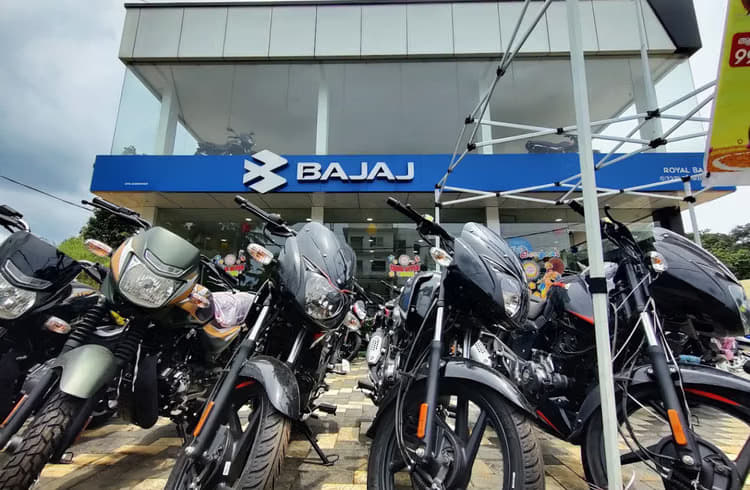
Bajaj Auto Ltd expects near-term motorcycle industry growth to moderate to around 7-9% from the over 20% growth seen in the fourth quarter, as the West Asia conflict starts weighing on supply chains, fuel-linked costs, consumer sentiment and retail prices.
Rakesh Sharma, Executive Director, Bajaj Auto, said April marked an inflection point for the industry after a strong March quarter, as the West Asia crisis led to LPG shortages, supply-chain disruptions, softer consumer sentiment, retail price inflation and outbound logistics complexity, particularly in overseas markets.
“This is slowing down the motorcycle category from the 20%-plus growth it was experiencing in quarter four to what we now think should be 7-9%. We noticed a considerable slowdown in April, and it will probably continue, with the industry performing at this level,” Sharma said.
According to Sharma, while the demand environment is expected to soften, the slowdown is not uniform across the market. The entry-level segment is likely to face greater pressure, while the premium end continues to hold up better.
“As usually happens when the demand environment gets tough, the bottom half suffers a little bit more and the top half sustains itself,” he said.
This works in Bajaj Auto’s favour as the company’s core focus remains the premium and performance motorcycle space, where it sells products under the Pulsar, Dominar, KTM, Husqvarna and Triumph brands. Sharma said the 150cc-plus motorcycle segment is expected to grow at nearly twice the pace of the overall industry. Customers with stronger purchasing power are still visiting showrooms and looking for better bikes, he added.
The company is also getting some support from exports. A weaker rupee is improving export realisations and providing a cushion against inflation.
According to Sharma, fuel prices will be a key monitorable going ahead as they not only drive inflation but also weigh heavily on consumer sentiment. Even a small increase in fuel prices can affect buyer confidence in the motorcycle market, especially at the entry level.
Higher vehicle prices are another pressure point, with raw material inflation, particularly in metals, prompting price increases of around 3-5% across parts of the industry, he said. “What this means is that GST has got reversed to an extent,” he said, adding that the GST rate cut had helped unlock demand in second half of FY26.
Electric vehicles, however, are showing stronger momentum. “In April, compared to Q4, EV has grown faster. While the ICE segments have slowed down, EV growth has taken off,” Sharma said.
In the Q4 FY26, Bajaj Auto sold 11,66,689 two-wheelers, up 24% from the year-ago period. Its commercial vehicle volumes, which largely comprise three-wheelers, rose 28% year-on-year to 2,04,369 units.
The company also reported a strong financial performance in Q4FY26. Standalone revenue from operations rose 32% year-on-year to ₹16,006 crore, while EBITDA increased 36% to ₹3,323 crore. EBITDA margin stood at 20.8%, up 60 basis points from a year earlier. Profit after tax before exceptional items rose 32% to ₹2,709 crore. For FY26, standalone revenue grew 17% to ₹58,732 crore, EBITDA rose 19% to ₹12,019 crore, and PAT before exceptional items increased 18% to ₹9,833 crore.
The broader FY27 industry outlook remains positive but more moderate. According to estimates discussed at the SIAM Looking Ahead Conclave, India’s two-wheeler market is expected to grow 6-8% in FY27, while the three-wheeler market is projected to grow 9-10%.

RELATED ARTICLES

Oben Electric Reaches 10,000-Unit Production Milestone at Bengaluru Plant
 Dev Vadchhedia
28 Sep 2026
Dev Vadchhedia
28 Sep 2026
Oben Electric said it has ramped up assembly to service 25,000 Rorr Evo bookings.


NSRCEL, Maruti Suzuki Launch Seventh Mobility Startup Cohort
 Eshisha Java
28 Sep 2026
Eshisha Java
28 Sep 2026
The six-month programme will support early-revenue to scale-stage startups across vehicle technology, clean tech, mobili...

GARC Upgrades Automotive Testing Infrastructure Under PM E-DRIVE
Eshisha Java
28 Sep 2026
The Chennai-based testing agency is adding EV, battery, ADAS, crash safety and heavy commercial vehicle testing capabili...