Follow us
BaaS isn’t really a service, it’s a financing tool: Tata Motors' Shailesh Chandra
The company frames the model not as a service but as a financing instrument, designed to help hesitant buyers visualise costs more clearly.
 20 Feb 2026
 3150 Views
Share -
3150 Views
Share -


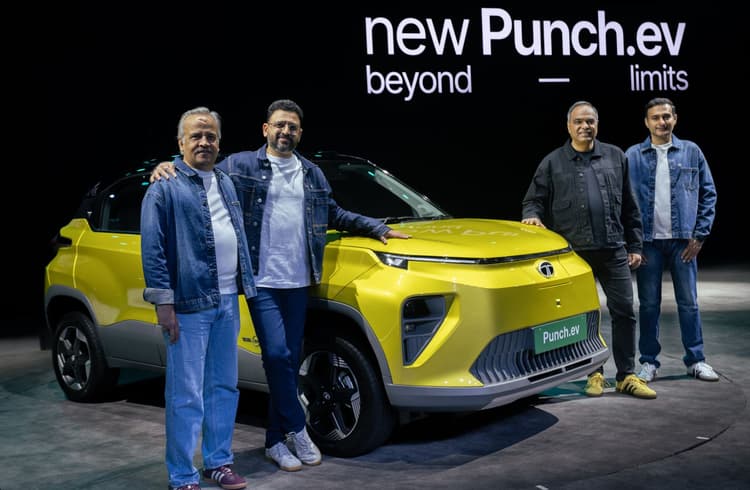
Launched at a starting price of ₹9.69 lakh, the Punch.ev pushes electric ownership closer to parity with ICE cars in the entry-level segment. But the more interesting move lies in the alternative pricing structure offered alongside it. Under a Battery-as-a-Service option, the upfront cost can drop to ₹6.49 lakh, with the battery payment structured separately at roughly ₹2.6 per kilometre.
To Managing Director Shailesh Chandra, however, the term BaaS itself is misleading. He describes the model not as a service but as a financing instrument designed to simplify the way customers understand EV costs. “It is not battery as a service. It’s basically a financing instrument,” Chandra said, explaining that the system works as a twin-EMI structure where the car and the battery are financed separately, often with a longer tenure aligned to the battery’s lifecycle. The intent is not to change ownership but to change perception.
The company had initially been reluctant to introduce the model and has chosen to restrict it to entry-level EV segment. Chandra said buyers at this end of the market face multiple psychological hurdles, from uncertainty about battery durability to difficulty comparing EV economics with petrol cars. Splitting the cost into vehicle and battery components is meant to help customers visualise what they are paying for in a more familiar way, almost like comparing a fuel bill with a battery usage cost.
The per-kilometre framing is deliberate. By translating battery financing into a running expense, Tata hopes customers can mentally compare EV usage with petrol spending rather than focusing only on the higher upfront price.
The decision was also influenced by competitive pressure. Even though adoption of battery financing in India remains extremely limited, Tata did not want to risk losing customers to rival offers experimenting with similar structures. Chandra acknowledged the model currently serves a niche audience and said the company is using it largely to study which customers find this kind of cost visualisation reassuring.
Industry estimates suggest BaaS penetration in India remains just 2-3% of EV sales, reinforcing Tata’s view that it is not yet a mainstream ownership format. Instead, the company sees it as an experimental bridge that may help some hesitant buyers cross into the electric market.
The broader strategy ties into a much larger opportunity. Chandra pointed out that roughly 65 percent of passenger vehicle sales in India occur below the ₹12 lakh price band, which is also close to the country’s median on-road car price. That mass segment is precisely where EV penetration remains weakest, and where Tata hopes the Punch.ev can function as a gateway product.
Other automakers have tried different approaches to the same affordability challenge. MG Motor India was among the first to introduce a battery financing structure in India, positioning it as a way to lower entry barriers for electric SUVs.
Globally, companies like NIO have built entire ecosystems around battery separation and swapping, treating BaaS as a core infrastructure strategy rather than a financing tweak. Tata’s version is far simpler, with no swapping network or subscription model, viewing it less as a long-term pillar and more as a transitional tool, Tata Motors said.

RELATED ARTICLES

MINI Cooper Oxford Edition Launched in India at Rs 55.50 Lakh
 Arunima Pal
16 Oct 2026
Arunima Pal
16 Oct 2026
The car will be imported as a completely built-up unit (CBU) and is based on the Favoured Pack.


Netradyne Wins Frost & Sullivan's 2026 Global Product Leadership Award for Fleet Video Telematics
 Angitha Suresh
16 Oct 2026
Angitha Suresh
16 Oct 2026
The San Diego-based AI fleet safety company was evaluated on innovation, customer value, reliability, growth potential, ...

VIDA Launches Limited-Edition Electric Off-Roader at 100th FIM International Six Days Enduro
Angitha Suresh
16 Oct 2026
Hero MotoCorp's electric vehicle brand VIDA has released a 100-unit numbered edition of its youth off-road bike in partn...