Follow us
How Tata Motors’ Lucknow Plant Evolved from the 407 Era to a Million-Vehicle Milestone
Tata Motors’ Lucknow plant has crossed the 1 million production milestone, marking over three decades of evolution since its origins in the Tata 407 era.
 2434 Views


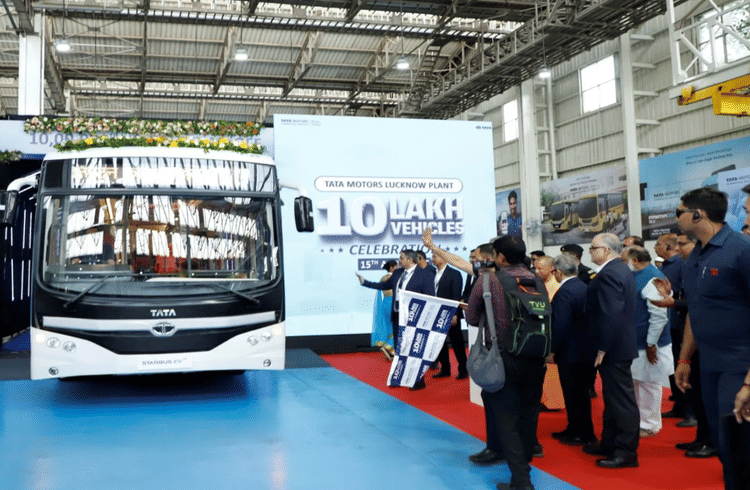
On April 25, 2026, the industrial landscape of Uttar Pradesh marked an important milestone as Tata Motors celebrated the rollout of its 10th lakh commercial vehicle from its Lucknow facility. This achievement is the culmination of a three-and-a-half-decade journey that began in the mid-1980s. At that time, the state government provided 6,000 acres on Deva Road, hoping a modern private-sector entrant could repair an industrial reputation then marred by labour unrest at state-owned firms. The plant’s first truck, a variant of the LP-1210, eventually debuted in late 1992, following a 1986 groundbreaking ceremony.
Strategic Entry
The decision to establish this greenfield site was deeply tied to the 1986 launch of the Tata 407. As a purely homegrown light commercial vehicle, the 407 did more than just capture the domestic market from international rivals; it effectively rescued the company from a financial crisis. The resulting surge in demand necessitated a specialised production hub beyond the traditional centres in Jamshedpur and Pune, positioning Lucknow as a critical pillar in Tata’s national strategy. Today, that strategy has evolved from simple assembly to high-tech customisation through an on-site Engineering Research Centre that validates new designs for specific customer needs.
Flexibility is Key
The facility's modern identity is defined by what leadership calls "multi-fuel" agility. Vishal Badshah, Vice President and Head of Operations at Tata Motors, notes that the plant is capable of producing diesel, CNG, electric, and hydrogen fuel cell vehicles on the same assembly lines. Badshah describes this integrated approach as one of the industry's most innovative practices, bolstered by a Digital Command Control Centre that monitors critical manufacturing processes in real time. This technological leap allows the plant to handle everything from 4-tonne light trucks to massive 55-tonne heavy-duty haulers without traditional production bottlenecks.
Expanding the Product Portfolio
A significant portion of the plant’s legacy involves its role in the bus segment, which currently accounts for roughly 25% of total production. This capability was sharpened by a 2006 partnership with the Brazilian firm Marcopolo S.A., which focused on "fully built" buses—vehicles delivered with the body and interior complete, rather than just the frame. Although Marcopolo exited the venture after 15 years to refresh its global strategy, Tata Motors successfully integrated the expertise, continuing to manufacture the Starbus and Ultra brands independently.
Way Ahead
Looking ahead, the Lucknow facility is positioned for significant growth without the immediate requirement for physical expansion. During the last fiscal year, the plant utilised approximately 60% of its one-lakh-unit annual capacity, producing 56,000 vehicles. This spare capacity provides a strategic cushion as the market shifts towards greener technologies like hydrogen and electric power.

RELATED ARTICLES

Built for 30,000, Running at 6,000: Godrej's New Forklift Plant is Waiting for India to Catch Up
 Shahkar Abidi
 08 Sep 2026
The 63-year-old business has moved almost all production to a new plant built for 15,000 units a year and is already eng...


KNR Hands Over a Transformed TVS Motor. What Next for Kargar?
 Autocar Professional Bureau
30 Aug 2026
Autocar Professional Bureau
30 Aug 2026
The incoming CEO inherits a stronger global business, growing positions in premium motorcycles and EVs, and the task of ...

Škoda‑Volkswagen Bets Big on India for a Strategic Turnaround
 Ketan Thakkar
29 Aug 2026
Ketan Thakkar
29 Aug 2026
Localisation and electrification are set to transform the group’s footprint in its most critical growth market outside E...