Follow us
India Could Halve Road Transport Emissions by 2050 if EV Targets Are Met, Study Finds
New ICCT analysis says domestic manufacturing and policy momentum give India a rare global climate opportunity.
 By Shristi Ohri
 2101 Views


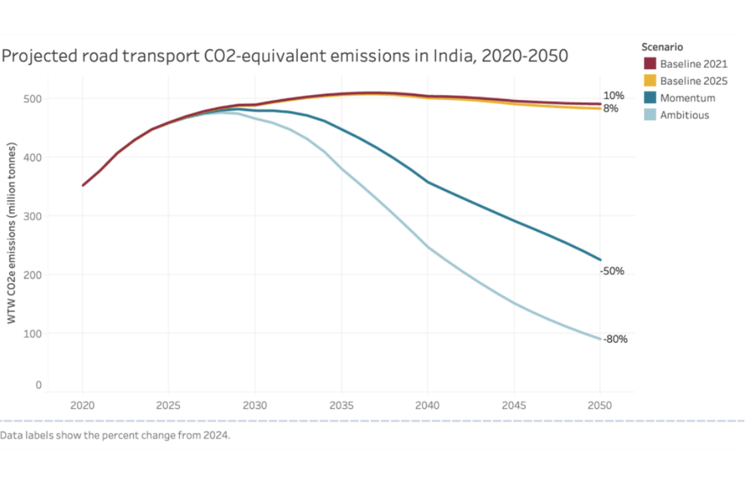
India could cut its road transport carbon dioxide-equivalent emissions by 50 per cent by mid-century if it fully meets its existing national and state-level electric vehicle targets, according to new research published by the International Council on Clean Transportation (ICCT).
The findings form part of the fourth edition of Vision 2050, the ICCT's annual assessment of the global transition to zero-emission vehicles. The report models the impact of current and proposed policies on vehicle sales, energy use and emissions through to 2050, across scenarios ranging from business-as-usual to ambitious policy action.
One of the report's most striking findings concerns India's domestic manufacturing base. Close to 80 per cent of all EVs sold in the country are already made domestically, placing India alongside the European Union and Japan — economies typically associated with mature industrial capacity. Analysts say this positions the country favourably to scale up its clean transport sector without heavy reliance on imports.
The ICCT also highlights India's ambitions in the heavy-duty vehicle sector, noting it is among a small number of emerging economies to have set long-term zero-emission goals for freight transport. The electrification of heavy goods vehicles is identified as a key source of future emissions reductions — a sector that has remained difficult to decarbonise globally.
The report is unambiguous on the role of policy in shaping India's EV trajectory. Unlike some markets where consumer demand and falling battery costs are the primary drivers, the ICCT finds that India's transition will depend heavily on regulatory interventions, including proposed fuel-efficiency norms, zero-emission vehicle targets, and state-level EV policies.
Current EV sales volumes remain modest, but the analysis projects that the adoption curve will steepen significantly during the 2030s as national and state policies take effect, with two- and three-wheelers, passenger cars, and eventually heavy-duty freight leading the shift.
Achieving the 50 per cent reduction would also support India's long-term net-zero target of 2070, while reducing dependence on imported fossil fuels — a vulnerability that has drawn increasing attention amid volatile global oil markets.

RELATED ARTICLES

High-Tech Two-Wheelers Power EV Revenue Surge at Auto Parts Supplier Sona
 Shahkar Abidi
 26 Oct 2026
The automotive component maker expands two-wheeler EV portfolio, driving record quarterly revenue.


MoRTH Amends CMVR to Formalise E100, B100 Testing Norms; Raises Light-Vehicle Test Limit to 3,500 kg
Shahkar Abidi
26 Oct 2026
Gazette notification provides clear homologation roadmap for flex-fuel vehicles.

Amara Raja Appoints Preetam Ganguly as Chief Business Officer for Industrial Business
 Dev Vadchhedia
26 Oct 2026
Dev Vadchhedia
26 Oct 2026
The former Cummins India executive takes charge of industrial battery segment as part of a leadership succession plan.