Follow us
Tata EV sales cross 300,000 units, hit a new high in March and FY2026
Tata Motors closed FY2026 with record passenger vehicle wholesales of 631,387 units including its highest-ever EV dispatches of 92,120 units for the fiscal year and 9,494 units in March, which take its cumulative electric car and SUV wholesales to 304,156 units since FY2021.
 7426 Views



Tata Motors has marched into FY2027 on the back of its strong market performance in FY2026. The company registered record wholesales of 631,387 units, up 14% YoY (FY2025: 553,585 PVs). This makes it the first time that the car and SUV manufacturer has surpassed the 600,000 milestone in in a single fiscal or calendar year. In CY2025, Tata Motors fell short of the 600,000 milestone with total passenger vehicle sales of 578,771 units (up 3%) including 81,125 EVs (up 18%).
In FY2026, Tata Motors’ six-model electric passenger vehicle portfolio, the largest amongst the mass-market OEMs, clocked record wholesales of 92,120 units, up 43% YoY (FY2025: 64,276 e-PVs) in FY2026, beating the previous best (FY2024: 73,833 units). While customer deliveries were tepid in Q1 FY2026 (16,231 units, down 2%), demand rose in Q2 (24,855 units, up 59%), Q3 (24,103 units, up 50%) and Q4 (26,931 units, up 69%). Among the reasons for retail sales rising from Q2 FY2026 was the launch of the Harrier EV in end-June 2025. Last fiscal saw Tata Motors’ EV sales surpass 9,000 units four times – September (9,191 units), October (9,286 units), January (9,052 units) and March (9,494 units). March 2026 now stands as the new benchmark for Tata EV sales.
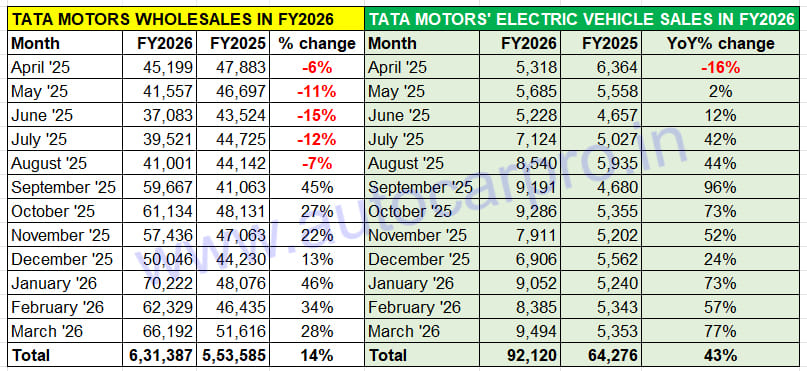 EV retail sales surpassed 9,000 units in September (9,191 units), October (9,286 units), January (9,052 units) and March (9,494 units). March 2026 is the new benchmark for Tata Motors EV sales.
The 92,120 e-PVs sold in FY2026 take Tata Motors’ cumulative e-car and e-SUV wholesales from FY2021 to 304,156 units, which makes Tata the first Indian e-PV maker to surpass the 300,000 EV milestone. Of this total, 230,229 units or 76% have been sold in the past three fiscal years, indicative of the growing demand for zero-emission PVs in India and also the expanding market.
While specific model-wise sales data is not available, it is understood that the Nexon EV, launched in January 2020, has sold well over 100,000 units and is the first made-in-India e-PV and e-SUV to achieve this milestone. The Tiago EV (launched in September 2022) and Punch EV (launched in January 2024) are the second and third highest-selling models. The other three Tata EV models comprise the Tigor EV rebadged XPres-T EV for the fleet segment (launched in August 2021), Curvv EV (launched in August 2024) and the Harrier EV (launched in June 2025).
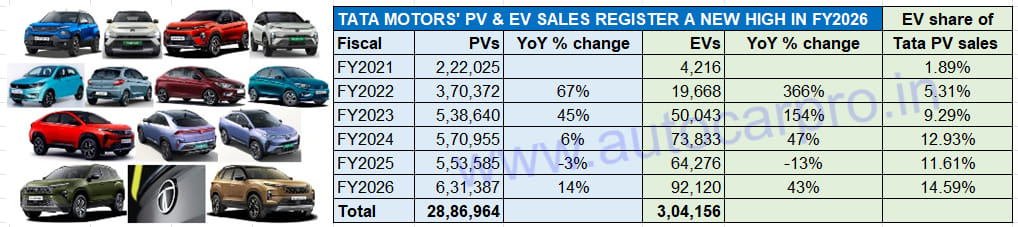
The 92,120 EVs sold in FY2026 constitute strong 43% YoY growth and a highest-yet 14.59% share of Tata Motors’ record passenger vehicle wholesales (factory dispatches) of 631,387 units.
TATA MOTORS’ EV PENETRATION LEVEL RISES TO HIGHEST IN FY2026: 15%
Like its CNG portfolio (estimated to have sold 170,000 units in FY2026), Tata Motors’ EVs have also helped drive sustained and strong growth for the company since FY2021 in the passenger vehicle market. In FY2021, EV sales at 4,216 had a 1.89% share of the 222,025 PVs. Electric PV sales rose YoY to 19,668 units in FY2022, 50,043 units in FY2023 and 73,833 units in FY2024 with the EV penetration level rising to 5.31%, 9.29% and 13%, respectively. Tata EV sales in FY2025 (64,276 units) were down 13% YoY and were a contributory factor in dragging overall PV sales down 3% to 553,585 units.
FY2026 has seen the company bounce back with its highest-ever fiscal wholesales of 92,120 EVs on the back of new product and facelift launches. While the Nexon EV, Tiago EV and Punch EV continue to have their share of buyers, the Harrier EV has helped accelerate demand. The Curvv coupe-SUV, however, is yet to achieve proper sales traction.
As a result of the surge in demand for Tata EVs in FY2026, the company’s EV penetration level has risen to 15%, up three percentage points from the 12% a year ago.
GROWING COMPETITION REDUCES TATA MOTORS’ RETAIL SALES SHARE TO 40%
While wholesales (factory dispatches to authorised dealers) are a strategic function of any automaker to keep their showrooms well stocked, the real-world story plays out in the retail sales numbers and new vehicle registrations. As per data on the Vahan portal, Tata Motors has delivered nearly 260,000 e-PVs since FY2021 (see data table below).
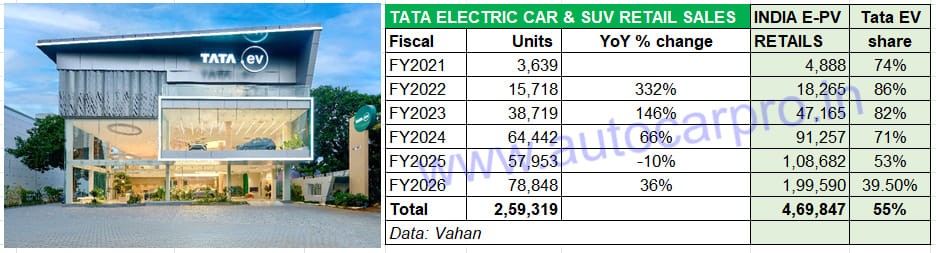 At 78,848 units, Tata EV retails hit a new high in FY2026 albeit market share (40%) has fallen from 71% in FY2024 with new competition from JSW MG Motor and Mahindra (combined 48% share).
While Tata Motors, which had the first-mover advantage, commanded an above-70% share of the e-PV market till FY2024, the past two fiscals have seen strong competition come in from two OEMs – JSW MG Motor India and Mahindra & Mahindra. While overall e-PV sales expanded with new product choice availability, the advance of these two rivals has seen Tata Motors’ e-PV market share reduce from 71% in FY2024 to 53% on FY2025 and now to 40% in FY2026. JSW MG Motor, riding on strong demand for its game-changing Windsor EV, delivered 53,145 EVs last fiscal (up 74% YoY) for a 27% e-PV market share, albeit marginally down from the 28% it had in FY2025. Mahindra & Mahindra, which launched the BE6 and XEV 9e in early 2025 and XEV 9S in December, has delivered 42,780 e-SUVs last fiscal, up 408% on a low base (FY2025: 8,424 e-SUVs), for a three-fold increase in e-PV market share to 21 percent. As a result, JSW MG and M&M together have a 48% share of the record 199,590 e-PVs sold in FY2026, leaving the remaining 13% to be fought over by the 14 other e-PV players. This a six-percentage points increase over the 36% e-PV share JSW MG and M&M had in FY2025.
Tata Motors, which is keen to regain its lost market share, has already witnessed fresh sales momentum with the launch of the Harrier EV and the facelifted Punch EV launched in February 2026 with two new larger battery options of 32 kWh and 40 kWh which offer a claimed 375km and 468km range respectively. It is now readying a clutch of new SUVs designed to draw buyers, keep the growing competition at bay and also capture fresh market share.
The first of the new EVs slated for launch is the Sierra EV in Q2 FY2027. This is the all-electric counterpart of the ICE-powered Sierra SUV which has drawn over 100,000 bookings and clocked wholesales of over 23,000 units since January this year. Then, there is the Safari EV, an EV derivative of the Tata Safari which is set to go on sale in India by the festive season (November 2026). The Safari EV, which will share underpinnings and powertrains with the Harrier EV, will also be the Indian carmaker’s first three-row EV.
End-CY2026 will see Tata Motors enter the premium EV segment with the Avinya brand with the first being a sportback car and the second likely to be the production-spec Avinya X SUV concept. The Avinya models will be based on the company’s dedicated born-electric Gen-3 skateboard EV platform.
ALSO READ: EV sales in India hit a record 2.45 million units in FY2026

RELATED ARTICLES

Record 207,850 e-2W sales in September power H1 FY027’s 1.12 million units
 Ajit Dalvi
 09 Oct 2026
Demand for electric 2-wheelers soared to a new monthly high of 207,850 units in September with Bajaj Auto and Hero Vida ...


TVS NTorq Surpasses 2.5 Million Sales, Last 500,000 Units Sold in 15 Months
Ajit Dalvi
07 Oct 2026
The TVS NTorq, launched in February 2018 as the company’s first 125cc scooter and then joined by its feature-laden 150cc...

Mahindra SUV Sales Rise 21% in CY2026 to 541,942 Units, Intense Battle With Tata Continues
Ajit Dalvi
05 Oct 2026
M&M surpasses half-a-million sales in first nine months of this year, benefiting from demand for most of its models as w...