Follow us
Construction Equipment Slips, Only Segment in Decline
FY26 CE retail fell 11.7% to 71,227 units, with broad‑based drops across OEMs and geographies.
 By Shruti Shiraguppi
 1708 Views


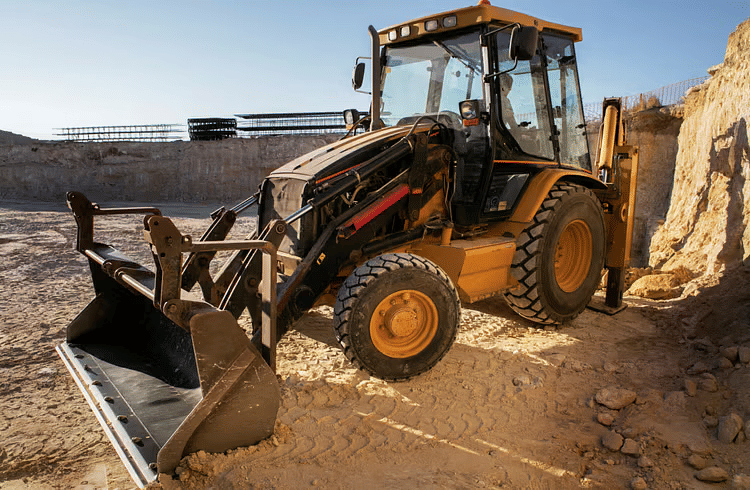
India's auto retail sector closed FY 2025-26 at an all-time high of nearly 2.97 crore units, with five of six vehicle categories posting annual records. Construction equipment (CE) was the exception — the only segment to finish the year in negative territory, declining 11.70% year-on-year to 71,227 units from 80,668 units in FY'25.
The Numbers in Context
The decline was consistent across both urban and rural geographies. Urban CE retail fell 8.99% over the full year, while rural CE fell a steeper 13.74%. In March 2026 — a month that saw the overall market surge 25.28% — CE volumes dipped 16.17% year-on-year to 6,906 units, compared to 8,238 in March 2025. Month-on-month, CE was essentially flat (up 2.75% from February's 6,721 units), offering little signal of a reversal.
OEM-Level Picture
JCB India retained its dominant position with a 48.62% market share in FY'26, though its absolute volumes fell from 39,782 to 34,632 units — a decline in excess of 13%. Action Construction Equipment, the second-largest player, also saw volumes drop from 9,258 to 7,416 units, with its market share contracting from 11.48% to 10.41%. Escorts Kubota's CE division, Tata Hitachi, and Case New Holland each posted modest volume declines as well. Ajax Engineering was among the few to hold roughly steady. The decline was therefore broad-based rather than concentrated in one or two players.
Fuel Mix: Almost Entirely Diesel
CE remains one of the most fuel-homogeneous segments in the market. Diesel accounted for 100% of CE retail in FY'26, effectively unchanged from FY'25's 99.78%. EV penetration, which stood at 0.14% in FY'25, slipped further to 0.10% in FY'26. CNG and petrol/ethanol together accounted for a negligible share in both years. This profile is consistent with the operational requirements of construction machinery, where diesel's energy density and refuelling infrastructure still have no practical alternative at scale.
What Likely Drove the Decline
Several factors appear to have weighed on CE volumes through the year, though the FADA data does not isolate causation directly.
First, CE is closely tied to infrastructure project execution rather than consumer sentiment — the primary driver that lifted most other vehicle segments in the second half of FY'26. GST 2.0's affordability effect, which proved significant for two-wheelers, passenger vehicles, and three-wheelers, had limited direct transmission to the CE segment, where buyers are typically contractors and project operators.
Second, the segment is sensitive to the pace of government capital expenditure disbursement and on-ground project activity. Project-level delays — whether from land acquisition bottlenecks, approval timelines, or seasonal construction lulls — can suppress equipment offtake even when broader infrastructure spending intentions are intact. FADA's own commentary noted project-level delays as a contributory factor.
Third, FY'25 may have provided a relatively elevated base. At 80,668 units, FY'25 CE volumes reflected a period of active infrastructure pipeline execution; any normalisation or delay in project commencement would show up as a decline in the following year.
FY'27 Outlook
Whether CE recovers in FY'27 will depend on factors outside the typical consumer demand cycle. If government infrastructure capex — particularly in roads, metro rail, urban development, and irrigation — translates into actual on-ground contract activity in the first two quarters, equipment demand should respond. The rabi harvest completion and improving rural cash flows noted in the FADA outlook are less directly relevant to CE than to tractors or two-wheelers.
The West Asia supply disruption flagged for April-June 2026 is worth monitoring for CE. While its most direct effects are on CV and PV supply chains, any broader disruption to global construction machinery components could affect lead times and variant availability.
The data points to economic slowdown risk (40.5% of dealers) and OEM supply disruption (30.5%) as the two most cited headwinds for the coming quarter. Both are plausible constraints for CE as well. At 71,227 units for the full year, CE sits at its lowest level.

RELATED ARTICLES

Vinfast India sells 14,600 EVs since market entry 14 months ago
 Ajit Dalvi
 16 Oct 2026
Vietnamese EV maker, which entered India in September 2025, delivers noteworthy performance to be ranked fourth in the e...


Hyundai Creta Sales Surpass 1.5 Million Units, Exports Nearing 300,000 Units
Ajit Dalvi
15 Oct 2026
Launched on July 21, 2015, Hyundai’s as well as India’s best-selling midsize SUV offered with petrol, diesel and electri...

Mahindra XUV 3XO crosses 500,000 sales ahead of new CNG model launch
Ajit Dalvi
14 Oct 2026
The XUV 3XO and its donor model, the XUV300, have surpassed half-a-million wholesales seven-and-a-half years after the X...